

















The LITIM Podcast
The Tell-Tale Heart
英検レベル別の解説
ポッドキャストで話している解説を、英検3級・2級・1級の3つのレベルの英語で書き直しました。 内容は同じなので、レベルを切り替えて読み比べられます。 色のついた単語をタップすると、やさしい英語で意味が出ます。
※ ポッドキャストの音声とは別の文章です。音声と同じ英文は ポッドキャストの原稿で読めます。
解説 1
The Tell-Tale Heart Story Summary
The Tell-Tale Heart is a short story by Edgar Allan Poe. He wrote it in 1843. A man tells the story himself, but we never learn his name. Again and again, he says, "I am not mad." He lives in the same house as an old man, and he likes the old man. The old man never did anything bad to him, and the man does not want his money. But the old man has one strange eye. It is pale blue, and it looks like the eye of a vulture, a big bird that eats dead animals. Because of this eye, the man decides to kill the old man.
For seven nights, he goes into the old man's room at midnight. But the eye is always closed, so he does nothing. On the eighth night, the old man wakes up. The man hears the old man's heart. It is beating fast because the old man is afraid. The man gets very angry and kills him. Then he hides the body under the floor.
Later, the police come to the house. The man is calm, and he is not afraid. But then he hears a quiet sound. It is the dead man's heart! It gets louder and louder. He thinks, "The police can hear it too. They are laughing at me." At last, he screams and tells them everything.
This is one of Poe's most famous scary stories. There is no ghost in it. The fear comes from the man's own mind. He did a terrible thing, and his mind turns against him.
解説 2
The Madman's Voice and the Evil Eye
The story does not start with an event. It starts with a voice. The man asks us, "Why will you say that I am mad?" He says that he is sick, but the sickness has made his ears very good. He can hear everything. He tells his story slowly and carefully. He wants to show us that his mind is clear.
But the more he talks, the less we believe him. He cannot stop thinking about the old man's eye. It is "a pale blue eye, with a film over it." He calls it the Evil Eye. He says that he does not hate the old man. He only hates the eye.
A storyteller like this is called an "unreliable narrator." We cannot believe everything he says. He explains and explains, and we see more and more clearly that he is mad. Only he himself cannot see it.
解説 3
The Eighth Night and the Beating Heart
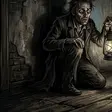
On the eighth night, the man is more careful than ever. He opens the door very, very slowly. But his thumb slips on his lamp, and it makes a noise. The old man sits up in bed and cries, "Who's there?" For a whole hour, the man does not move.
Then the man opens his lamp a little. A thin line of light falls on the eye. The eye is wide open. Then he hears a quiet, quick sound, like a watch inside cotton. It is the old man's heart. The old man is very afraid, and his heart is beating hard. The sound gets louder and louder. The man is afraid that a neighbour will hear it. He shouts, jumps into the room, and kills the old man. Then he cuts up the body and hides it under three boards in the floor. He is sure that nobody will find it.
Poe uses sound to make us afraid. We feel the beating heart before we understand it.
解説 4
The Heartbeat and the Confession
At four in the morning, three police officers come to the house. A neighbour heard a scream in the night. The man is very calm. He even puts his chair right on top of the place where the body is.
The officers sit and talk. Then the man hears a ringing in his ears. It turns into a quiet sound, like a watch inside cotton. It is the same sound as before. The heartbeat is back, and it gets louder and louder.
The man thinks, "The officers can hear it. They know, and they are laughing at me." He cannot stand it anymore. He screams that he killed the old man. He tells them to pull up the boards, because the terrible heart is beating there.
The man said that he was not mad, and he said that he was not afraid. But in the end, the sound of his bad feelings tells his secret. Only he can hear it. That is the meaning of the title. The heart that tells the secret is his own.
解説 1
The Tell-Tale Heart Story Summary
"The Tell-Tale Heart," written by Edgar Allan Poe in 1843, is the confession of a nameless narrator who keeps insisting that he is not mad. He lives with an old man whom he actually loves. The old man has never hurt him, and he does not want the old man's gold. Only one thing troubles him: the old man's pale, filmy eye, which looks like the eye of a vulture. Because of this eye, he decides to kill him.
For seven nights, he quietly enters the old man's room at midnight, but the eye is always closed, so he cannot carry out his plan. On the eighth night, the old man wakes up. The narrator hears the beating of a terrified heart, becomes furious, and kills him. He then hides the body beneath the floorboards.
When the police arrive, he is calm and confident. Soon, however, he begins to hear a low, dull sound: the beating of the dead man's heart, growing louder and louder. Believing that the officers can hear it too and are making fun of him, he finally breaks down and screams out his confession.
In this masterpiece of psychological horror, the terror does not come from a ghost. It comes from a guilty mind turning against itself.
解説 2
The Madman's Voice and the Evil Eye
The story begins not with events but with a voice, a voice desperate to prove that it is sane. "True! — nervous — very, very dreadfully nervous I had been and am; but why will you say that I am mad?" The narrator claims that his illness has made his senses sharper, especially his hearing. He presents his calm, careful storytelling as proof that his mind is sound.
However, each time he protests, our doubts only grow. He is obsessed with the old man's eye, "a pale blue eye, with a film over it," which he calls the Evil Eye. He says he feels no hatred toward the man himself, only toward the eye.
This is the horror of the unreliable narrator. The more carefully he explains himself, the more clearly we see the madness that he cannot see in himself.
解説 3
The Eighth Night and the Beating Heart
On the eighth night, the narrator is more careful than ever, opening the door so slowly that a watch's minute hand moves faster than his. But just as he is about to open his lantern, his thumb slips on its metal fastening. The old man sits up in bed and cries out, "Who's there?" For a whole hour, neither of them moves.
At last, the narrator opens the lantern a tiny bit, and a single thin ray falls on the vulture eye. It is wide open. Then he hears a low, quick sound, "such as a watch makes when enveloped in cotton." It is the beating of the old man's terrified heart. The sound grows louder and louder, until he fears that a neighbour will hear it. With a loud yell, he leaps into the room and kills the old man. He then cuts the body into pieces and hides it beneath three planks of the floor, sure that no eye could ever discover his crime.
Poe turns sound into fear. The heartbeat drives the terror forward, and we feel it before we understand it.
解説 4
The Heartbeat and the Confession
At four o'clock in the morning, three police officers arrive. A neighbour heard a shriek during the night and reported it. The narrator is perfectly calm. He even places his own chair on the very spot where the body lies.
But as the officers chat, he begins to hear a ringing in his ears. It turns into a low, dull sound, "such as a watch makes when enveloped in cotton," the same sound as before. The heartbeat has returned, and it grows louder and louder.
He becomes convinced that the officers can hear it too and are only pretending not to, mocking his horror. Finally, he can bear it no longer. "Villains!" he shrieks, "dissemble no more! I admit the deed! — tear up the planks! — here, here! — It is the beating of his hideous heart!"
The guilt he refused to admit has become a sound that only he can hear, and it destroys him. In the end, the real tell-tale heart is his own.
解説 1
The Tell-Tale Heart Story Summary
"The Tell-Tale Heart," which Edgar Allan Poe published in 1843, takes the form of a confession by an anonymous narrator who protests, with mounting vehemence, that he is not mad. He professes affection for the old man with whom he shares a house; the old man has never wronged him, and he harbours no designs on his gold. What torments him is a single feature: a pale, filmy eye reminiscent of a vulture's, which ultimately drives him to murder.
For seven consecutive nights he steals into the old man's chamber at midnight, only to find the eye invariably shut. On the eighth night the old man wakes. Hearing the frantic pounding of a terrified heart, the narrator is seized by fury, slays his victim, and conceals the corpse beneath the floorboards.
When the police call, he receives them with composure and self-assurance — until a low, dull throbbing begins to assail him: the heartbeat of the dead man, swelling ever louder. Persuaded that the officers hear it too and are merely feigning ignorance to mock him, he finally cracks and shrieks out his confession.
In this masterpiece of psychological horror, dread emanates not from anything supernatural but from a guilt-ridden mind that turns upon itself.
解説 2
The Madman's Voice and the Evil Eye
The story opens not with incident but with a voice — one frantically determined to vindicate its own sanity. "True! — nervous — very, very dreadfully nervous I had been and am; but why will you say that I am mad?" The narrator contends that his malady has sharpened rather than dulled his senses, above all his hearing, and he offers the composure of his narration as evidence of a rational mind.
Yet every protestation only deepens our misgivings. His fixation centres on the old man's eye — "a pale blue eye, with a film over it" — which he dubs the Evil Eye. Toward the man himself, he insists, he bears no animosity; his hatred is reserved for the eye alone.
Herein lies the peculiar horror of the unreliable narrator: the more meticulously he justifies himself, the more starkly we perceive the derangement to which he himself remains oblivious.
解説 3
The Eighth Night and the Beating Heart
On the eighth night, the narrator's caution reaches its height; he eases the door open so gradually that a watch's minute hand outpaces him. Just as he is about to open his lantern, however, his thumb slips on the tin fastening, and the old man starts up in bed, crying out, "Who's there?" For an entire hour, neither stirs.
At length the narrator opens the lantern a mere crack, and a solitary ray, fine as a spider's thread, falls full upon the vulture eye — wide, wide open. Then comes the sound: low, dull, and quick, "such as a watch makes when enveloped in cotton" — the pounding of the old man's petrified heart. As it swells to a pitch he fears a neighbour might overhear, he throws open the lantern, leaps into the room with a yell, and smothers the old man beneath his own heavy bed. He then dismembers the corpse and secretes it beneath three planks of the chamber floor, confident that no eye could ever detect his crime.
Poe transmutes sound into dread: the heartbeat is the engine of the terror, sensed viscerally long before it is understood.
解説 4
The Heartbeat and the Confession
At four in the morning, three police officers arrive, dispatched after a neighbour reported hearing a shriek in the night. The narrator is the picture of composure; in the wild audacity of his triumph, he even sets his own chair upon the very spot beneath which the corpse lies.
But as the officers make small talk, a ringing begins in his ears, and it gradually resolves into a low, dull sound — "such as a watch makes when enveloped in cotton" — the very sound he heard before. The heartbeat has returned, growing ever louder.
Convinced that the officers hear it too and are merely feigning ignorance to deride his anguish, he can endure it no longer. "Villains!" he shrieks, "dissemble no more! I admit the deed! — tear up the planks! — here, here! — It is the beating of his hideous heart!"
The guilt he so strenuously disavowed has materialised as a sound audible to him alone, and it brings about his downfall. The true tell-tale heart, in the end, is his own.
