
Grammar Patterns
Grammar patterns found in 竹取物語 (The Tale of the Bamboo Cutter, Part 1), with examples from the story. JLPT levels are estimates.
-
JLPT N4 estimated
受身(〜られる)
Meaning: Passive voice: the subject receives the action.
Form: Verb passive form(追い上げられる / 沈められる)
In this story
-
むかし、竹取の翁とよばれるおじいさんがいました。
Long ago, there was an old man who was called the Old Bamboo Cutter.
-
-
JLPT N4 estimated
〜と(発見)
Meaning: "When I did ..., (I found that) ...": what one noticed right after an action.
Form: Verb (plain / polite) + と
In this story
-
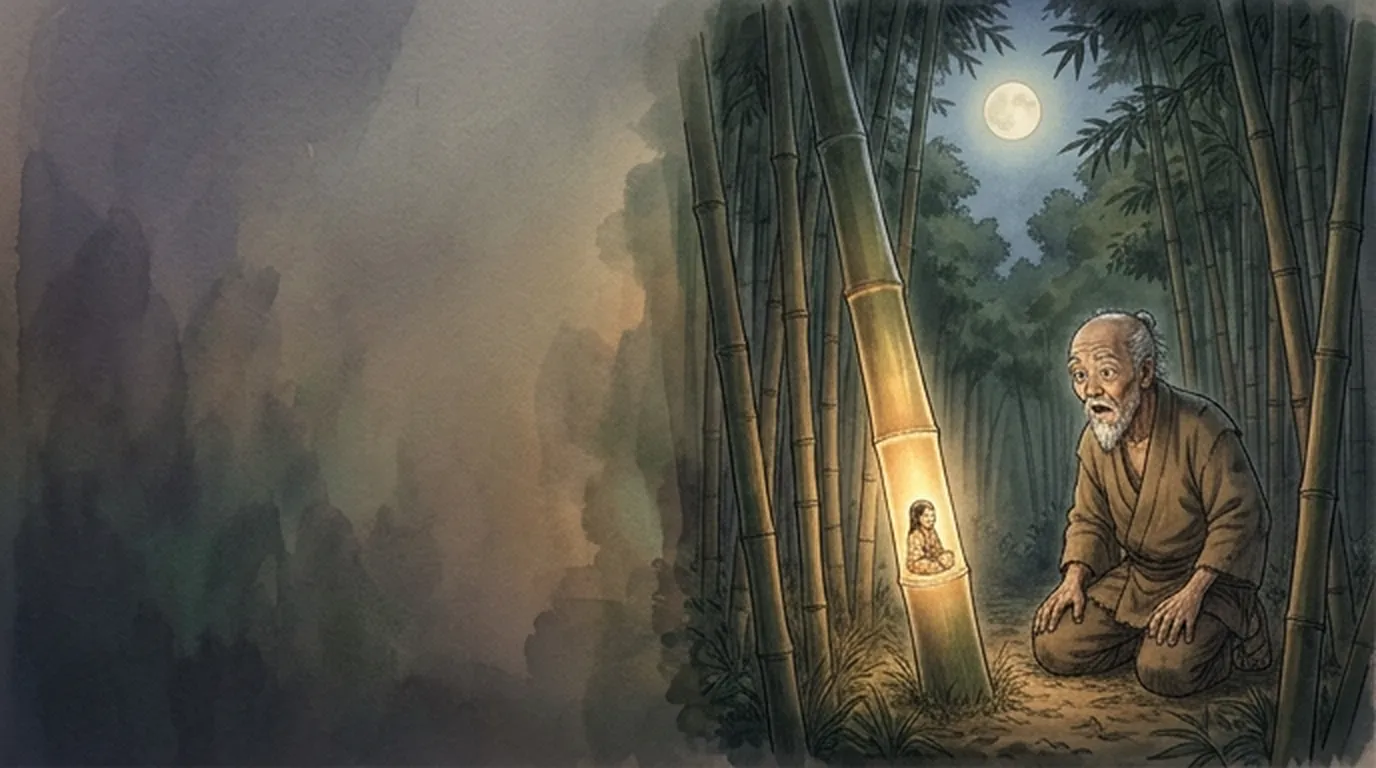
ある日、おじいさんがいつものように竹やぶに入ると、根もとが光っている竹が一本ありました。
One day, when the old man went into the bamboo grove as usual, there was one stalk of bamboo whose base was shining.
-
そっと切ってみると、中に小さな女の子が座っていました。
When he gently cut it open, a tiny girl was sitting inside.
-
-
JLPT N4 estimated
〜てみる
Meaning: "Try ...ing; ... and see".
Form: Verb て-form + みる(見る)
In this story
-
「ふしぎだなあ」と思って近くへ行ってみると、竹の中がぼんやりと光っています。
"How strange," he thought, and when he went closer to look, the inside of the bamboo was glowing faintly.
-
せめて一目でいいから見てみたい」と思いました。
One glance would be enough, at least; I want to see her," they thought.
-
-
JLPT N3 estimated
特別な尊敬語(いらっしゃる・おっしゃる・くださる)
Meaning: Special honorific verbs that show respect for the person who acts: いらっしゃる (to be, come, go), おっしゃる (to say), くださる (to give).
Form: いる / 来る / 行く → いらっしゃる、言う → おっしゃる、くれる → くださる
In this story
-
「毎朝毎晩見ている竹の中にいらっしゃったのだから、きっと、わたしの子になる人なのだろう。」
"Since she was inside the bamboo that I look at every morning and every evening, she must surely be the one who is to become my child."
-
おじいさんがそうおっしゃるのなら、結婚しないとは言いません。
If you say so, I will not say that I won't marry.
-
ですから、わたしが見たいと思うものを持ってきてくださった方を、いちばん心の深い方だと考えて、その方と結婚しましょう。」
So I will consider the one who brings me the thing I want to see to be the one with the deepest heart, and I will marry that person."
-
-
JLPT N4 estimated
〜だろう(推量)
Meaning: "Probably ...; I bet ...": the speaker's guess (casual form of でしょう).
Form: Plain form + だろう
In this story
-
「毎朝毎晩見ている竹の中にいらっしゃったのだから、きっと、わたしの子になる人なのだろう。」
"Since she was inside the bamboo that I look at every morning and every evening, she must surely be the one who is to become my child."
-
-
JLPT N4 estimated
〜てもらう
Meaning: "Have someone do ...; get someone to do ...": someone does something for you (or for the person the story follows).
Form: Verb て-form + もらう
In this story
-
おじいさんは女の子を手のひらにのせて家に帰り、おばあさんに育ててもらいました。
The old man put the girl on the palm of his hand and went home, and had the old woman bring her up.
-
おじいさんは、三室戸の斎部のあきたという人をよんで、女の子に名前をつけてもらいました。
The old man sent for a man called Mimurodo no Inbe no Akita and had him give the girl a name.
-
-
JLPT N4 estimated
〜ので
Meaning: "Because ...; so ...": gives a reason (softer than から).
Form: Plain form + ので(Noun / な-adj + なので)
In this story
-
二人には子どもがいなかったので、おばあさんもとても喜びました。
The two of them had no children, so the old woman was very happy too.
-
女の子はあまりに小さかったので、かごの中に入れて大切に育てました。
The girl was so small that they put her in a basket and raised her with great care.
-
-
JLPT N5 estimated
〜に行く(目的)
Meaning: "Go to do ...": the purpose of going.
Form: Verb ます-stem + に行く
In this story
-
それからというもの、おじいさんが竹を取りに行くと、ふしぎなことが何度も起こりました。
Ever since then, when the old man went to gather bamboo, strange things happened again and again.
-
-
JLPT N4 estimated
〜のだ/〜のです
Meaning: Explains a situation or gives the reason behind it ("the thing is ...").
Form: Plain form + のだ / のです(Noun / な-adj + なのだ)
In this story
-
竹を切ると、節と節の間に黄金が入っているのです。
When he cut a stalk of bamboo, there was gold between the joints.
-
-
JLPT N4 estimated
〜てくる
Meaning: Something comes toward the speaker, or a change starts and goes on ("it's getting ...").
Form: Verb て-form + くる
In this story
-
次の日も、その次の日も、切る竹切る竹の中から、光る黄金が出てきました。
The next day, and the day after that, shining gold came out of every stalk he cut.
-
-
JLPT N4 estimated
〜ていく
Meaning: A change goes on from now (or from that point) into the future ("keep ...ing; go on getting ...").
Form: Verb て-form + いく
In this story
-
こうして、おじいさんの家はだんだんお金持ちになっていきました。
In this way, the old man's household gradually became rich.
-
ふつうの子どもよりずっと早く、一日ごとに目に見えて大きくなっていきます。
Much faster than an ordinary child, she grew visibly bigger day by day.
-
-
JLPT N5 estimated
〜より(比較)
Meaning: "Than ...": the thing something is compared with.
Form: Noun + より
In this story
-
ふつうの子どもよりずっと早く、一日ごとに目に見えて大きくなっていきます。
Much faster than an ordinary child, she grew visibly bigger day by day.
-
-
JLPT N3 estimated
〜くらい(程度)
Meaning: "So ... that ...; to the extent that ...": shows degree with an example.
Form: Plain form + くらい(ぐらい)
In this story
-
三か月ほどたつと、もう大人と同じくらいの背の高さになっていました。
After about three months, she was already as tall as an adult.
-
-
JLPT N4 estimated
〜ように(比喩)
Meaning: "Like ...; as if ...": compares something to something else.
Form: Noun + の / Verb (plain) + ように
In this story
-
おじいさんとおばあさんは、女の子の髪を上げて、大人の女性が着る長いスカートのような服を着せてあげました。
The old man and the old woman put up the girl's hair and dressed her in clothes like the long skirt that grown women wear.
-
-
JLPT N3 estimated
〜ほど(程度)
Meaning: "So ... that ...; to the point of ...": shows how far something goes.
Form: Plain form / Noun + ほど
In this story
-
その顔の美しさは、この世のものとは思えないほどでした。
The beauty of her face was such that it did not seem to belong to this world.
-
-
JLPT N4 estimated
〜ても
Meaning: "Even if ...; no matter ...": the result does not change.
Form: Verb て-form + も
In this story
-
腹が立っていても、そんな気持ちはどこかへ消えてしまいました。
Even when he was angry, that feeling disappeared somewhere.
-
家の人に話しかけても、だれも相手にしてくれません。
Even when they spoke to the people of the house, nobody paid any attention to them.
-
-
JLPT N4 estimated
〜てしまう
Meaning: Shows that an action is completely finished, often with regret or an unwanted result.
Form: Verb て-form + しまう
In this story
-
腹が立っていても、そんな気持ちはどこかへ消えてしまいました。
Even when he was angry, that feeling disappeared somewhere.
-
-
JLPT N4 estimated
〜という(名前)
Meaning: "Called ...; named ...": gives the name of a person or thing.
Form: Name + という + Noun
In this story
-
おじいさんは、三室戸の斎部のあきたという人をよんで、女の子に名前をつけてもらいました。
The old man sent for a man called Mimurodo no Inbe no Akita and had him give the girl a name.
-
-
JLPT N4 estimated
〜たり〜たりする
Meaning: "Do things like ... and ...": gives some examples from several actions.
Form: Verb た-form + り、Verb た-form + り + する
In this story
-
たくさんの人がやってきて、にぎやかに歌ったり踊ったりしました。
Many people came, and they sang and danced merrily.
-
それでも男たちは、家の前で笛をふいたり、歌を歌ったり、手紙を何通も書いたりしました。
Even so, the men played flutes in front of the house, sang songs, and wrote letter after letter.
-
-
JLPT N5 estimated
〜たい
Meaning: "Want to ...": the speaker's wish.
Form: Verb ます-stem + たい
In this story
-
身分の高い人も低い人も、「なんとかしてかぐや姫をお嫁さんにしたい。
People of high rank and people of low rank alike — "Somehow I want to make Kaguya-hime my bride.
-
-
JLPT N3 estimated
〜ずに
Meaning: "Without ...ing" (written style of 〜ないで).
Form: Verb ない-stem + ずに(する → せずに)
In this story
-
男たちは夜も眠らずに家のまわりを歩きまわり、垣根にすき間を作ってのぞこうとしました。
The men walked around the house without sleeping even at night, and made gaps in the hedge to try to peek in.
-
-
JLPT N3 estimated
〜ようとする
Meaning: "Try to ...; be about to ...".
Form: Verb volitional form + とする(と致す)
In this story
-
男たちは夜も眠らずに家のまわりを歩きまわり、垣根にすき間を作ってのぞこうとしました。
The men walked around the house without sleeping even at night, and made gaps in the hedge to try to peek in.
-
-
JLPT N4 estimated
〜ことができる
Meaning: "Can ...; be able to ...".
Form: Verb (dictionary) + ことができる(ことはできない)
In this story
-
けれども、かぐや姫の姿を見ることはできませんでした。
But they were not able to see Kaguya-hime.
-
-
JLPT N4 estimated
〜てくれる
Meaning: Someone does something for the speaker (or for the person the story follows).
Form: Verb て-form + くれる
In this story
-
家の人に話しかけても、だれも相手にしてくれません。
Even when they spoke to the people of the house, nobody paid any attention to them.
-
あなたも、あの五人のだれかと結婚してくれませんか。」
Won't you, too, marry one of those five?"
-
-
JLPT N4 estimated
〜なくなる
Meaning: "Stop ...ing; no longer ...": something that used to happen does not happen any more.
Form: Verb ない-stem + なくなる
In this story
-
やがて、たいていの男たちはあきらめて、来なくなりました。
Before long, most of the men gave up and stopped coming.
-
-
JLPT N4 estimated
可能形(〜られる)
Meaning: Potential form: "can ...; be able to ...".
Form: Verb potential form(生きられる / 読める)
In this story
-
わたしはもう七十を過ぎて、いつまで生きられるかわかりません。
I am already past seventy, and I do not know how long I will be able to live.
-
-
JLPT N3 estimated
〜ものだ(当然)
Meaning: "It is natural that ...; that is how things are": states something as a general rule.
Form: Verb (dictionary) + ものだ(ものです)
In this story
-
この世では、男の人と女の人は結婚するものです。
In this world, men and women marry; that is the way things are.
-
-
JLPT N4 estimated
〜(の)なら
Meaning: "If (that is the case) ...": takes up what the other person said or what the situation is.
Form: Plain form + (の)なら / Noun + なら
In this story
-
おじいさんがそうおっしゃるのなら、結婚しないとは言いません。
If you say so, I will not say that I won't marry.
-
-
JLPT N3 estimated
〜まま
Meaning: "As it is; still ...": a state continues without changing.
Form: Noun + の / Verb た-form + まま
In this story
-
でも、相手の心がどれくらい深いのか知らないまま結婚して、あとで相手の気持ちが変わってしまったら、きっと後悔します。」
But if I marry without knowing how deep the other person's heart is, and his feelings change later, I will surely regret it."
-
-
JLPT N4 estimated
〜たら
Meaning: "If / when ...": a condition, often about one particular case.
Form: Verb た-form + ら
In this story
-
でも、相手の心がどれくらい深いのか知らないまま結婚して、あとで相手の気持ちが変わってしまったら、きっと後悔します。」
But if I marry without knowing how deep the other person's heart is, and his feelings change later, I will surely regret it."
-
-
JLPT N4 estimated
〜ばいい
Meaning: "All you have to do is ...; you can just ...".
Form: Verb ば-form + いい
In this story
-
「では、どうすればいいのですか。」
"Then what should we do?"
-
-
JLPT N4 estimated
〜そうだ(様態)
Meaning: "Looks like ...; seems about to ...": based on how something looks or feels.
Form: Verb ます-stem / Adjective stem + そうだ
In this story
-
夕方になると、五人はうれしそうにやってきました。
When evening came, the five arrived looking happy.
-
-
JLPT N4 estimated
〜かもしれない
Meaning: "Might ...; may ...": possibility.
Form: Plain form + かもしれない(かも知れません)
In this story
-
「ついに、かぐや姫が会ってくれるのかもしれない」と、だれもが思っていました。
"At last, Kaguya-hime may be going to meet us," everyone was thinking.
-
-
JLPT N5 estimated
〜でしょう(推量)
Meaning: "Probably ...": the narrator's guess.
Form: Plain form + でしょう(でございましょう)
In this story
-
いったい、かぐや姫は何を持ってこいと言うのでしょうか。
What on earth will Kaguya-hime tell them to bring?
-