
Part 1 · Commentary
Commentary 2
The Gate and the Old Woman
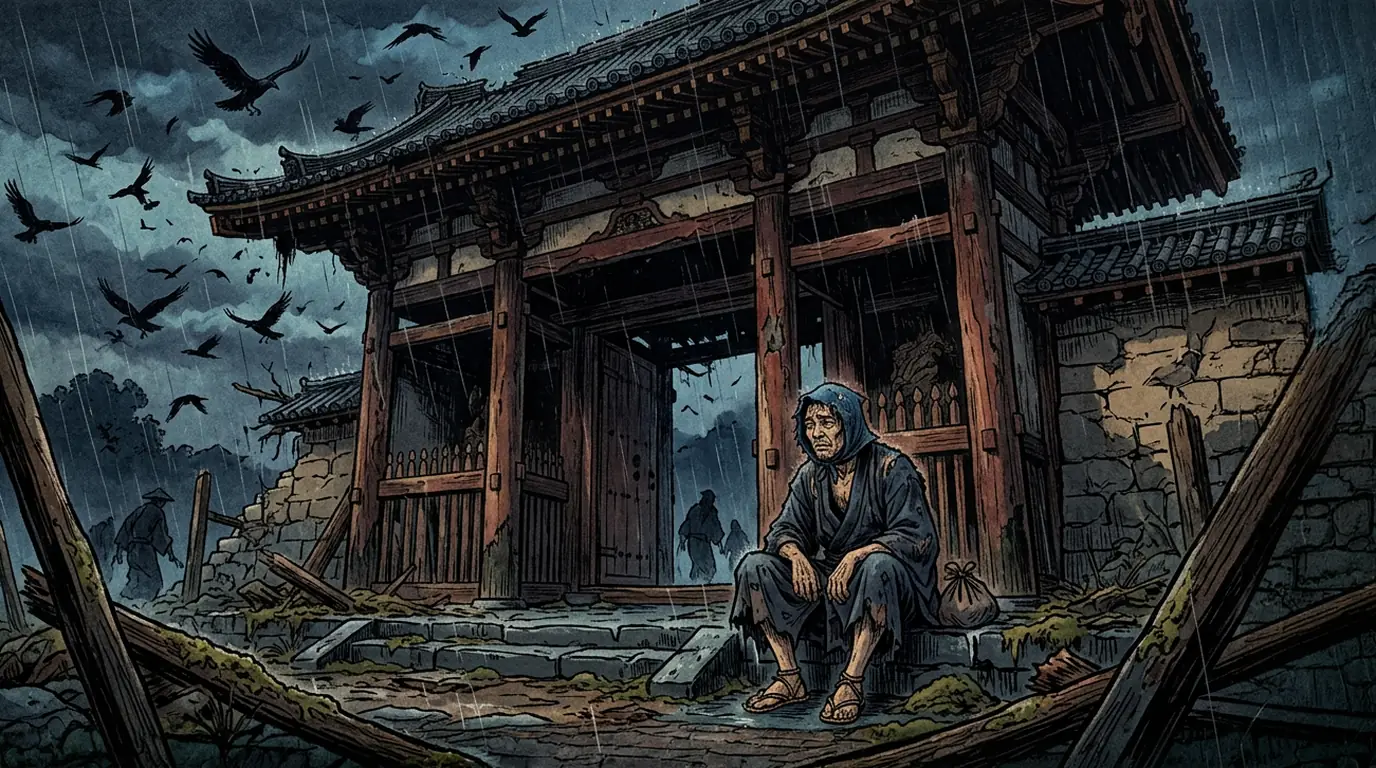
舞台は平安時代の京都。地震、つむじ風、火事、飢饉と災いが続き、都はすっかり荒れ果てています。羅生門も修理されないまま、狐や盗人が住みつき、ついには引き取り手のない死体が捨てられる場所になっていました。
The setting is Kyoto in the Heian period. Earthquakes, whirlwinds, fires and famine have come one after another, and the capital lies in ruins. Rashōmon has been left unrepaired too. Foxes and thieves have moved in, and in the end it has become a place where bodies that no one will claim are thrown away.
下人は、ひと晩を明かそうと、門の上の楼へはしごを登ります。すると、誰もいないはずの楼の中に、火がともっています。死体のあいだにうずくまっていたのは、猿のように痩せた、白髪の老婆でした。老婆は、女の死体から、髪の毛を一本ずつ抜いています。
The servant climbs a ladder to the tower above the gate, hoping to get through the night there. But in the tower, where no one should be, a light is burning. Crouching among the dead bodies is an old woman with white hair, as thin as a monkey. She is pulling the hair out of a dead woman's head, one hair at a time.
Commentary 3
Anger, an Excuse, a Robbery
それを見た下人の心に、激しい怒りが燃え上がります。ついさっきまで盗人になろうかと迷っていた男が、このときばかりは、迷わず飢え死にを選んだだろう、と語り手は言います。
At the sight, a fierce anger flares up in the servant's heart. A moment ago he was wondering whether to become a thief. Just then, the narrator says, he would have chosen to starve without a second thought.
下人は老婆をねじ伏せ、何をしていたのかと問いただします。老婆は答えます。髪を抜いて、かつらにするつもりだった。この女だって、生きているときは、蛇を干したものを干し魚だと言って売っていた。そうしなければ飢え死にするのだから、仕方がない。自分のすることも、仕方がないことだ。この女もきっと大目に見てくれるだろう、と。
The servant forces the old woman to the floor and demands to know what she was doing. The old woman answers. She was pulling out the hair to make a wig. This woman, too, when she was alive, used to sell dried snake and say it was dried fish. If she had not, she would have starved, so it could not be helped. What the old woman is doing cannot be helped either. Surely this woman would forgive her, she says.
これを聞いているうちに、下人の心に、ある勇気が生まれてきます。門の下では、どうしても出てこなかった勇気です。下人は言います。「では、おれが引きはぎをしようと恨むまいな。おれもそうしなければ、飢え死にをする体なのだ」。そして老婆の着物をはぎ取り、蹴倒して、はしごを駆け下りていきます。
As he listens, a certain courage is born in the servant's heart. It is the courage that would not come to him under the gate. The servant says: "Then you won't blame me if I rob you. I'll starve too if I don't." He tears off the old woman's kimono, kicks her down, and runs down the ladder.
Commentary 4
Three Things to Notice
読みどころを三つ挙げます。
Here are three things to notice.
一つ目は、下人の心が、短いあいだに何度もひっくり返ることです。迷い、怒り、そして盗み。この男の中で、善と悪は固まっていません。その場の状況と、理屈ひとつで入れ替わります。しかも下人が使った理屈は、老婆が自分を守るために口にした「仕方がない」を、そのまま老婆に向けて返したものでした。
The first is how the servant's heart turns over again and again in a short time. Doubt, anger, and then theft. In this man, good and evil are not fixed. They change places with the situation in front of him and a single piece of reasoning. And the reasoning he uses is the very "it can't be helped" that the old woman said to protect herself, turned straight back on her.
二つ目は、にきびです。下人は右の頬に大きなにきびがあって、物語のあいだじゅう、それを気にして触っています。ところが、盗人になると決めた瞬間、その手がにきびから離れます。迷っていた若者が、迷うのをやめたしるしとして、よく注目される場面です。
The second is the pimple. The servant has a large pimple on his right cheek, and all through the story he keeps touching it. But the moment he decides to become a thief, his hand leaves the pimple. Readers often point to this scene as the sign that a young man who could not decide has stopped hesitating.
三つ目は、最後の一文です。「下人の行方は、誰も知らない」。じつは、最初に発表されたときの結末は違いました。下人は雨の中、京都の町へ強盗を働きに急いでいた、とはっきり書かれていたのです。芥川は数年後、本に収め直すときにこれを書き換えて、男の行き先を消しました。下人はそのまま盗人になったのか、それとも、どこかで引き返したのか。答えは、読む人に預けられています。
The third is the last sentence. "Where the servant went, no one knows." In fact, the ending was different when the story was first published. It said clearly that the servant was hurrying through the rain to the streets of Kyoto to commit robbery. A few years later, when the story went into a book, Akutagawa rewrote this and erased where the man was going. Did the servant go on to be a thief, or did he turn back somewhere? The answer is left to the reader.
あなたが下人だったら、あのはしごを下りたあと、どこへ向かうでしょうか。後半は、この問いを二人で話してみます。
If you were the servant, where would you go after climbing down that ladder? In the second half, two people talk this question over.
Part 2 · Conversation: Mio and Ken
Conversation 1
Where Did He Go?
ここからは二人で話します。ミオです。
From here on, it's the two of us. I'm Mio.
ケンです。さっきの問い、いきなり難しいよね。
And I'm Ken. That question just now is a hard one to start with, isn't it?
自分があの男だったら、はしごを下りたあと、どこへ行くか。
If you were that man, where would you go after climbing down the ladder?
ミオはどう思う?
What do you think, Mio?
わたしは、そのまま町へ行って、次の盗みをすると思う。
I think he'd go straight into town and steal again.
迷わず?
Without hesitating?
迷わず。だって、一回やっちゃったんだよ。もう戻るところがない。
Without hesitating. I mean, he's already done it once. There's nowhere to go back to.
僕は逆かな。朝になったら、怖くなって動けなくなる気がする。
I think the opposite. I have a feeling that when morning comes, he'll get scared and won't be able to move.
えー、あんなに勢いよく駆け下りたのに?
What? After running down the ladder with all that energy?
勢いだからだよ。あの男、ずっと気分で動いてるでしょ。
It's because it was all energy. That man acts on his mood the whole time, doesn't he?
気分。
His mood.
Conversation 2
Anger, Contempt and "Courage"
おばあさんを見つけたとき、すごく怒るじゃない。でもあの時点では、なんで髪を抜いているのか知らないんだよ。
When he finds the old woman, he gets really angry, right? But at that point he doesn't know why she's pulling out the hair.
あ、そうか。理由を聞く前に怒ってる。
Oh, that's true. He's angry before he hears the reason.
雨の夜に、あんな場所で、死んだ人の髪を抜いている。それだけでもう許せない、って書いてある。
On a rainy night, in a place like that, pulling the hair out of a dead person. The story says that alone is already unforgivable.
正義というより、ぞっとしたんだね。
So it wasn't so much justice. It gave him the creeps.
そう。で、理由を聞いたら、かつらにする、でしょ。
Right. And then when he asks the reason, it's to make a wig.
意外と普通の理由。
A surprisingly ordinary reason.
そこで男は、がっかりするんだよ。答えが平凡すぎて。
And that's where the man feels let down. The answer is too ordinary.
がっかりするんだ。もっとすごい悪を期待してたのかな。
He feels let down! Maybe he was hoping for a much greater evil.
たぶんね。がっかりして、それから相手を見下しはじめる。
Probably. He's let down, and then he starts to look down on her.
怒りが、軽蔑に変わる。わたし、そこがいちばん怖い。
Anger turns into contempt. To me, that's the scariest part.
怖い?
Scary?
怒っているうちは、まだ相手を同じ人間だと思ってる気がするの。見下したら、もう何をしてもよくなる。
While you're angry, I feel you still see the other person as a human being like you. Once you look down on them, you can do anything to them.
ああ、なるほど。だから着物をはぎ取れた。
Ah, I see. That's why he could tear off her kimono.
しかもさ、あの男、刀を持ってるんだよ。
And on top of that, the man has a sword.
持ってる。おばあさんの目の前に突きつけてる。
He does. He holds it right in front of the old woman's eyes.
刀を持った若い男が、何も持っていないおばあさんから着物を取る。それを語り手は、勇気って呼ぶの。
A young man with a sword takes the kimono from an old woman who has nothing. And the narrator calls that courage.
あれは皮肉だよね。門の下では出てこなかった勇気、って。
That's irony, isn't it? "The courage that would not come to him under the gate."
いちばん弱い相手にだけ出てくる勇気。
A courage that only comes out against the weakest person.
きついなあ。でも、自分にもある気がして笑えない。
That's harsh. But I can't laugh, because I feel I have some of it too.
Conversation 3
"It Can't Be Helped"
わかる。それと、仕方がない、っていう言葉。
I know. And then there are the words "it can't be helped."
おばあさんが言うやつ。
The thing the old woman says.
死んだ女も、生きるために人をだましていた。だから、わたしが髪を抜いても仕方がない。
The dead woman also cheated people in order to live. So it can't be helped if I pull out her hair.
それを聞いた男が、じゃあ自分が奪っても仕方がないな、と。
And the man hears that and thinks, well then, it can't be helped if I rob you.
順番に、弱いほうへ弱いほうへ回っていくんだよね。
It gets passed along, one after another, to the weaker one, and then the weaker one.
ということは、次はあの男の番だよ。
Which means it's that man's turn next.
次?
Next?
誰かがあの男から奪っても、仕方がない、で済んでしまう。自分で認めた理屈だから。
Even if someone robs that man, "it can't be helped" will settle it. Because it's a reasoning he accepted himself.
うわ、そうか。あの理屈、使った人を守ってくれないんだ。
Wow, you're right. That reasoning doesn't protect the person who uses it.
だから僕は、朝になったら怖くなると思うんだよ。
That's why I think he'll get scared when morning comes.
Conversation 4
The Pimple and the Last Line
なるほどね。でもわたしは、やっぱり町へ行くと思う。
I see. But I still think he goes into town.
どうして?
Why?
にきび。
The pimple.
にきび?
The pimple?
ずっと触っていたのに、決めた瞬間に手を離したでしょ。あれは、もう考えるのをやめた手だと思う。
He'd been touching it the whole time, but the moment he decided, he took his hand away, right? I think that's the hand of someone who has stopped thinking.
考えるのをやめた人は、止まらないか。
And a person who has stopped thinking doesn't stop, you mean.
うん。考え直すには、もう一回にきびを触らないと。
Yes. To think again, he'd have to touch the pimple one more time.
その言い方はいいな。
I like the way you put that.
ケンは最後の場面、覚えてる?
Ken, do you remember the last scene?
おばあさんが、はしごのところまで、床をはっていく。
The old woman crawls across the floor to the top of the ladder.
そう。白い髪を逆さにして、門の下をのぞきこむ。
Yes. With her white hair hanging upside down, she looks down under the gate.
でも見えるのは、真っ暗な夜だけ。
But all she can see is the pitch-black night.
わたしたちも、あのおばあさんと同じ場所から見ているんだよね。
We're looking from the same place as that old woman, aren't we?
男の背中は、もう見えない。
We can't see the man's back anymore.
最初の結末のままだったら、強盗をしに急いでいた、で終わりでしょ。
If the first ending had stayed, it would just end with him hurrying off to rob someone.
そうしたら今日のこの話、三十秒で終わってた。
And then today's talk would have been over in thirty seconds.
芥川が最後の一文を書き換えてくれたおかげで、百年たってもまだ話せる。
Because Akutagawa rewrote that last sentence, we can still talk about it a hundred years later.
で、結局どっちだと思う?
So in the end, which do you think it is?
わたしは、町へ行った、に一票。
One vote from me for "he went into town."
僕は、門の近くの暗がりで、着物を抱えたまま朝を待っている、に一票。
One vote from me for "he's in the dark near the gate, holding the kimono, waiting for morning."
決まらないね。
We can't settle it.
決まらないのが正解なんだと思う。
I think not settling it is the right answer.
聞いているあなたは、どちらでしょうか。
And you, listening: which do you think it is?
それでは、また次の作品で。
Well then, see you at the next story.
さようなら。
Goodbye.
Commentary 1
About Rashomon
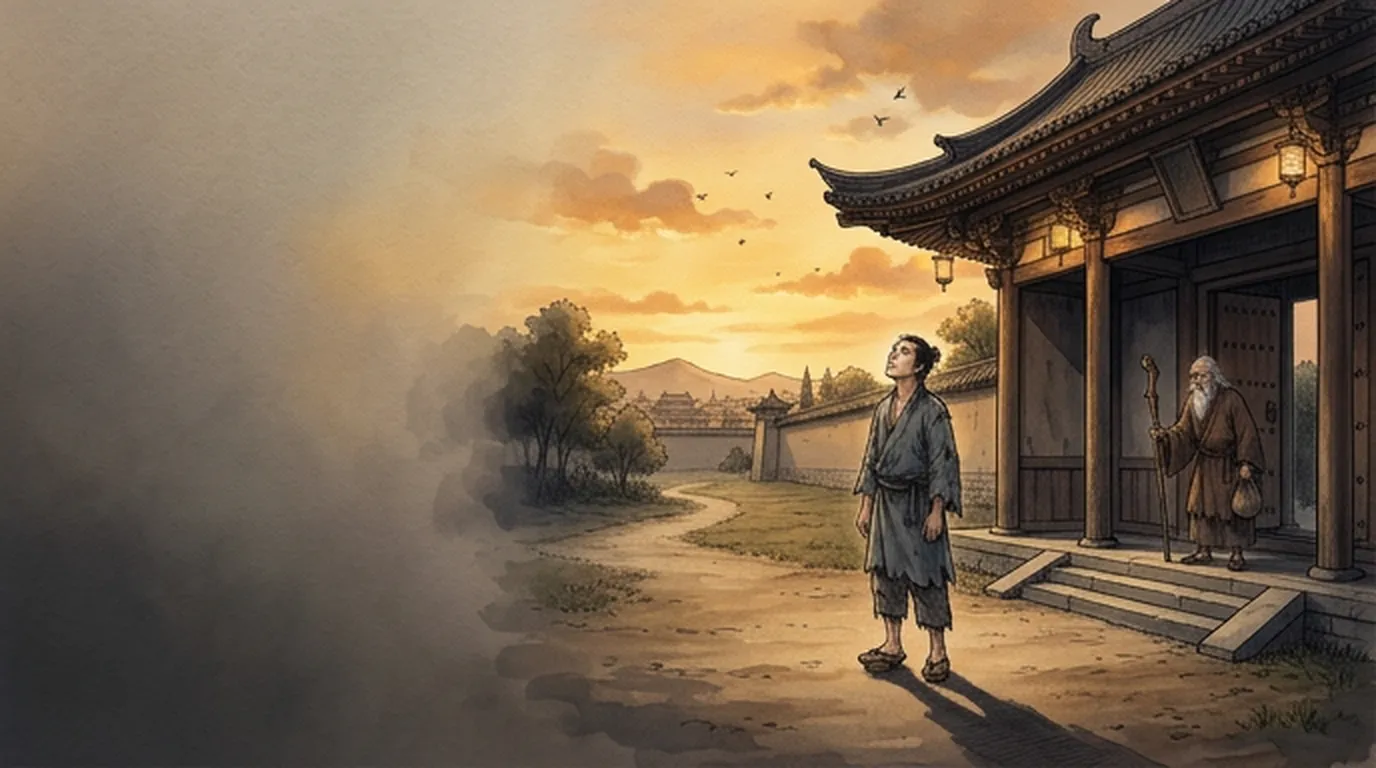
ある雨の夕暮れ、ひとりの男が、門の下で雨がやむのを待っています。行くあてはありません。長年つとめた主人から、数日前に暇を出されたばかりだからです。このまま飢え死にするか、それとも盗人になるか。芥川龍之介の「羅生門」は、この二択の前で立ち止まった男の、ほんの短い時間を描いた物語です。
One rainy evening, a man is waiting under a gate for the rain to stop. He has nowhere to go. A few days ago, the master he had served for many years dismissed him. Should he starve to death as things are, or become a thief? Ryūnosuke Akutagawa's "Rashōmon" is the story of a very short time in the life of a man who has stopped in front of these two choices.
発表されたのは一九一五年、大正四年。芥川は二十三歳、まだ東京帝国大学の学生でした。雑誌「帝国文学」に載りましたが、当時はほとんど話題になりませんでした。それがいまでは高校の国語の教科書の定番になり、日本でもっとも広く読まれている短編のひとつになっています。
It came out in 1915, the fourth year of the Taishō era. Akutagawa was twenty-three and still a student at Tokyo Imperial University. It was printed in the magazine Teikoku Bungaku, but at the time hardly anyone talked about it. Today it is a regular part of high school Japanese textbooks, and one of the most widely read short stories in Japan.
ちなみに、黒澤明の映画「羅生門」は、題名と門の舞台をこの作品から借りていますが、話の中身は芥川の別の短編「藪の中」です。
By the way, Akira Kurosawa's film "Rashomon" borrows its title and the setting of the gate from this story, but its plot comes from another short story by Akutagawa, "In a Grove."
下敷きになったのは、平安時代の説話集「今昔物語集」に収められた話です。ただし、元の話の男は、はじめから盗みをするつもりで都に来た盗人でした。芥川はそれを、まだ盗人になりきれない男に書き換えています。この作品の面白さは、ほとんどこの書き換えから生まれています。
The story is based on a tale in the Konjaku Monogatarishū, a collection of tales from the Heian period. In the original tale, though, the man was a thief who had come to the capital meaning to steal from the start. Akutagawa rewrote him as a man who cannot quite become a thief yet. Almost everything that makes this story interesting comes from that change.