
Grammar Patterns
Grammar patterns found in 羅生門 (Rashōmon), with examples from the story. JLPT levels are estimates.
-
JLPT N1 estimated
〜そうなものだ
Meaning: "One would expect ...; surely there ought to be ...": what should naturally be the case (but isn't).
Form: Verb ます-stem + そうなものだ(ありそうなものである)
In this story
-
羅生門が、朱雀大路にある以上は、この男のほかにも、雨やみをする市女笠や揉烏帽子が、もう二三人はありそうなものである。
Since the Rashōmon stands on Suzaku Avenue, you would expect two or three other people — women in broad hats, men in soft caps — to be sheltering there from the rain as well.
-
-
JLPT N3 estimated
〜さえ
Meaning: "Even ...": the most extreme example, so the rest goes without saying.
Form: Noun (+ particle) + さえ
In this story
-
とうとうしまいには、引取り手のない死人を、この門へ持って来て、棄てて行くと云う習慣さえ出来た。
In the end, people even began bringing unclaimed dead bodies to this gate and leaving them there.
-
-
JLPT N4 estimated
〜ことになる
Meaning: "It turns out that ...; it comes to be that ...": a situation that results, not one's own decision.
Form: Verb (plain) + ことになる(事になる)
In this story
-
そこで、日の目が見えなくなると、誰でも気味を悪るがって、この門の近所へは足ぶみをしない事になってしまったのである。
So once the sun had gone down, everyone found the place creepy, and it came to be that no one would set foot near the gate.
-
-
JLPT N4 estimated
〜ように(比喩)
Meaning: "Like ...; as if ...": compares something to something else.
Form: Noun + の / Verb (plain) + ように
In this story
-
ことに門の上の空が、夕焼けであかくなる時には、それが胡麻をまいたようにはっきり見えた。
Especially when the sky above the gate glowed red at sunset, the crows stood out clearly, like scattered sesame seeds.
-
その老婆は、右の手に火をともした松の木片を持って、その死骸の一つの顔を覗きこむように眺めていた。
Holding a burning piece of pine wood in her right hand, the old woman was gazing at the face of one of the bodies as if peering into it.
-
-
JLPT N2 estimated
〜せいか
Meaning: "Perhaps because ...": a possible cause, often of something negative.
Form: Plain form / Noun + の + せいか
In this story
-
――もっとも今日は、刻限が遅いせいか、一羽も見えない。
— Today, though, perhaps because it was late, not a single crow could be seen.
-
-
JLPT N4 estimated
〜ながら
Meaning: "While ...ing": two actions by the same person at the same time.
Form: Verb ます-stem + ながら
In this story
-
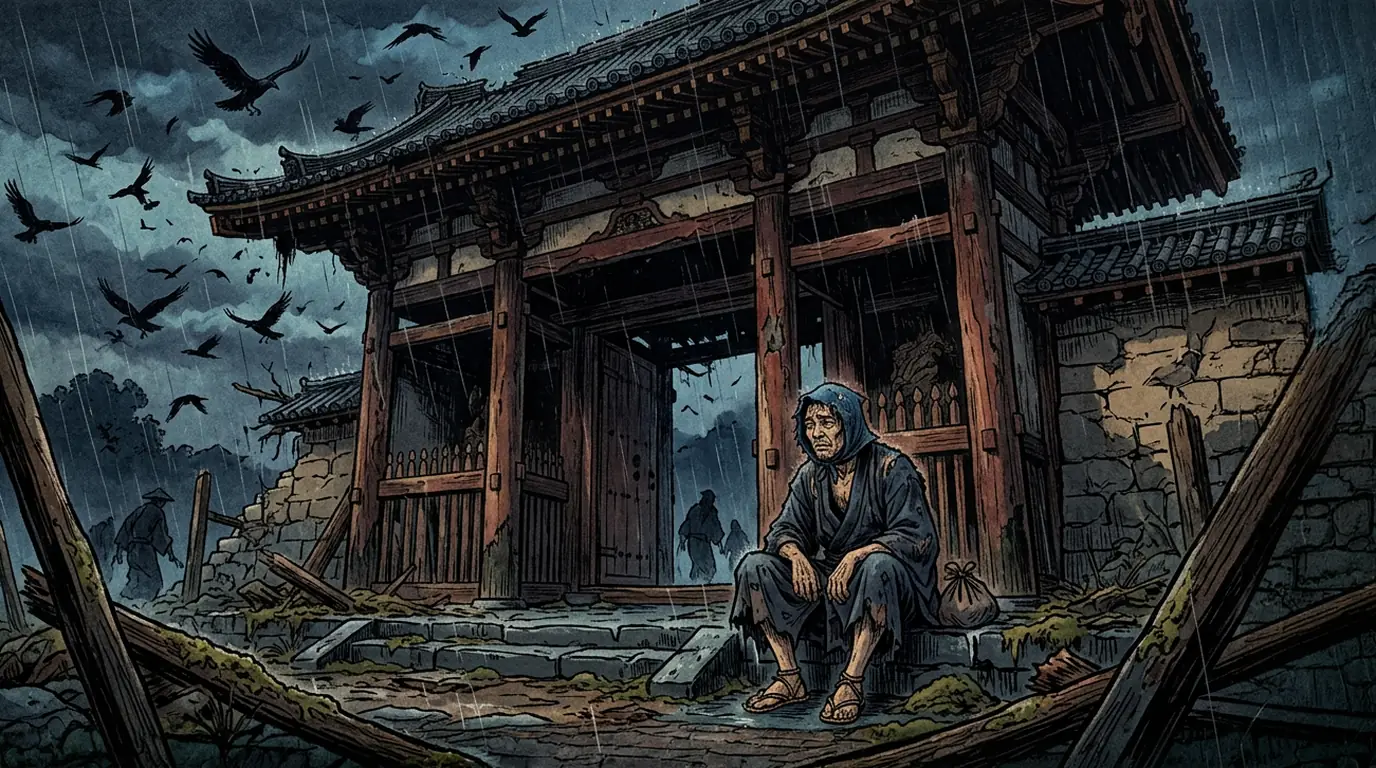
下人は七段ある石段の一番上の段に、洗いざらした紺の襖の尻を据えて、右の頬に出来た、大きな面皰を気にしながら、ぼんやり、雨のふるのを眺めていた。
The servant sat on the top of the seven stone steps in his faded blue jacket, fussing over a large pimple on his right cheek as he gazed vacantly at the falling rain.
-
下人は、手段を選ばないという事を肯定しながらも、この「すれば」のかたをつけるために、当然、その後に来る可き「盗人になるよりほかに仕方がない」と云う事を、積極的に肯定するだけの、勇気が出ずにいたのである。
Even while the servant accepted that he would not be choosy about the means, he still lacked the courage to go further and accept what had to follow if he was to settle that "if" — that there was nothing else to do but become a thief.
-
-
JLPT N3 estimated
〜べき
Meaning: "Should ...; ought to ...": what is proper or expected. 可き is an old way of writing べき.
Form: Verb (dictionary) + べき(可き)(する → すべき)
In this story
-
ふだんなら、勿論、主人の家へ帰る可き筈である。
Normally, of course, he should have gone back to his master's house.
-
-
JLPT N1 estimated
〜にほかならない
Meaning: "Is nothing other than ...": states strongly what something really is.
Form: Noun + にほかならない
In this story
-
今この下人が、永年、使われていた主人から、暇を出されたのも、実はこの衰微の小さな余波にほかならない。
That this servant had now been dismissed by the master he had served for so many years was, in fact, nothing other than a small ripple of this decline.
-
-
JLPT N2 estimated
〜というより
Meaning: "Rather than (saying) ..., (it's more that) ...": a better way to describe something.
Form: Plain form / Noun + というより(と云うよりも)
In this story
-
だから「下人が雨やみを待っていた」と云うよりも「雨にふりこめられた下人が、行き所がなくて、途方にくれていた」と云う方が、適当である。
So rather than saying "the servant was waiting for the rain to stop," it would be more accurate to say "the servant, shut in by the rain with nowhere to go, was at a loss."
-
-
JLPT N3 estimated
〜ようとする
Meaning: "Try to ...; be about to ...".
Form: Verb volitional form + とする(と致す)
In this story
-
そこで、下人は、何をおいても差当り明日の暮しをどうにかしようとして――云わばどうにもならない事を、どうにかしようとして、とりとめもない考えをたどりながら、さっきから朱雀大路にふる雨の音を、聞くともなく聞いていたのである。
So, trying above all to do something about how he would live tomorrow — trying, so to speak, to do something about what could not be helped — the servant followed his rambling thoughts, and for some time he had been half-listening to the sound of the rain falling on Suzaku Avenue.
-
-
JLPT N1 estimated
〜ともなく
Meaning: "Without really meaning to ...": doing something absent-mindedly (聞くともなく聞く = to half-listen).
Form: Verb (dictionary) + ともなく + same verb
In this story
-
そこで、下人は、何をおいても差当り明日の暮しをどうにかしようとして――云わばどうにもならない事を、どうにかしようとして、とりとめもない考えをたどりながら、さっきから朱雀大路にふる雨の音を、聞くともなく聞いていたのである。
So, trying above all to do something about how he would live tomorrow — trying, so to speak, to do something about what could not be helped — the servant followed his rambling thoughts, and for some time he had been half-listening to the sound of the rain falling on Suzaku Avenue.
-
-
JLPT N4 estimated
〜ば
Meaning: "If ...": a condition; the result follows when the condition is met.
Form: Verb ば-form (行けば / すれば)
In this story
-
選んでいれば、築土の下か、道ばたの土の上で、饑死をするばかりである。
If he were choosy, he would only starve to death at the foot of an earthen wall or on the ground by the roadside.
-
-
JLPT N2 estimated
〜ばかりだ
Meaning: "Nothing but ...; only ...": this one thing is all that happens or remains.
Form: Verb (dictionary) + ばかりだ(ばかりである)
In this story
-
選んでいれば、築土の下か、道ばたの土の上で、饑死をするばかりである。
If he were choosy, he would only starve to death at the foot of an earthen wall or on the ground by the roadside.
-
外には、ただ、黒洞々たる夜があるばかりである。
Outside there was nothing but the pitch-black, cavernous night.
-
-
JLPT N2 estimated
〜た挙句(に)
Meaning: "After ... (for a long time), finally ...": the result after much effort or trouble.
Form: Verb た-form + 挙句に(揚句に)
In this story
-
選ばないとすれば――下人の考えは、何度も同じ道を低徊した揚句に、やっとこの局所へ逢着した。
If he were not choosy — after wandering along the same path again and again, the servant's thoughts had finally arrived at this point.
-
-
JLPT N2 estimated
〜よりほか(に)仕方がない
Meaning: "There is nothing else to do but ...": the only option left.
Form: Verb (dictionary) + よりほかに仕方がない
In this story
-
下人は、手段を選ばないという事を肯定しながらも、この「すれば」のかたをつけるために、当然、その後に来る可き「盗人になるよりほかに仕方がない」と云う事を、積極的に肯定するだけの、勇気が出ずにいたのである。
Even while the servant accepted that he would not be choosy about the means, he still lacked the courage to go further and accept what had to follow if he was to settle that "if" — that there was nothing else to do but become a thief.
-
-
JLPT N3 estimated
〜ずに
Meaning: "Without ...ing" (written style of 〜ないで).
Form: Verb ない-stem + ずに(する → せずに)
In this story
-
下人は、手段を選ばないという事を肯定しながらも、この「すれば」のかたをつけるために、当然、その後に来る可き「盗人になるよりほかに仕方がない」と云う事を、積極的に肯定するだけの、勇気が出ずにいたのである。
Even while the servant accepted that he would not be choosy about the means, he still lacked the courage to go further and accept what had to follow if he was to settle that "if" — that there was nothing else to do but become a thief.
-
-
JLPT N3 estimated
〜ほど(程度)
Meaning: "So ... that ...; to the point of ...": shows how far something goes.
Form: Plain form / Noun + ほど
In this story
-
夕冷えのする京都は、もう火桶が欲しいほどの寒さである。
In the evening chill, Kyoto was so cold that one longed for a brazier.
-
-
JLPT N4 estimated
〜てしまう
Meaning: Shows that an action is completely finished, often with regret or an unwanted result.
Form: Verb て-form + しまう
In this story
-
丹塗の柱にとまっていた蟋蟀も、もうどこかへ行ってしまった。
The cricket that had been on the red-painted pillar had already gone off somewhere.
-
-
JLPT N4 estimated
〜と(発見)
Meaning: "When I did ..., (I found that) ...": what one noticed right after an action.
Form: Verb (plain / polite) + と
In this story
-
それが、梯子を二三段上って見ると、上では誰か火をとぼして、しかもその火をそこここと動かしているらしい。
Yet when he climbed two or three steps up the ladder, it seemed that someone up there had lit a light and was moving it here and there.
-
-
JLPT N2 estimated
〜からには
Meaning: "Since ...; now that ...": because this is so, a natural conclusion follows. からは is an older form.
Form: Plain form + からには(からは)
In this story
-
この雨の夜に、この羅生門の上で、火をともしているからは、どうせただの者ではない。
Anyone who was lighting a fire up on the Rashōmon on a rainy night like this was surely no ordinary person.
-
-
JLPT N3 estimated
〜とおり(に)
Meaning: "Just as ...; exactly as ...".
Form: Verb た-form / Noun + の + とおり(通り)
In this story
-
見ると、楼の内には、噂に聞いた通り、幾つかの死骸が、無造作に棄ててあるが、火の光の及ぶ範囲が、思ったより狭いので、数は幾つともわからない。
When he looked, he saw that, just as the rumors said, a number of dead bodies had been carelessly thrown inside the tower, but the firelight reached less far than he had thought, so he could not tell how many there were.
-
-
JLPT N1 estimated
〜であろう(推量)
Meaning: "Probably ...; must have ...": literary / old-fashioned form of 〜だろう.
Form: Plain form / Noun + であろう(であろ)
In this story
-
髪の毛の長い所を見ると、多分女の死骸であろう。
Judging from the long hair, it was probably a woman's body.
-
-
JLPT N2 estimated
〜に従って
Meaning: "As ... (changes), ... (also changes)"; also "following ...; in step with ...".
Form: Noun / Verb (dictionary) (+ の) + に従って
In this story
-
髪は手に従って抜けるらしい。
The hair seemed to come out easily as her hands pulled.
-
その髪の毛が、一本ずつ抜けるのに従って、下人の心からは、恐怖が少しずつ消えて行った。
As the hairs came out one by one, the fear in the servant's heart faded little by little.
-
-
JLPT N4 estimated
〜らしい(推量)
Meaning: "It seems ...; apparently ...": a guess based on what one sees or hears.
Form: Plain form + らしい
In this story
-
髪は手に従って抜けるらしい。
The hair seemed to come out easily as her hands pulled.
-
-
JLPT N3 estimated
〜に対する/〜に対して
Meaning: "Toward ...; against ...": the target of a feeling or action.
Form: Noun + に対する + Noun / Noun + に対して
In this story
-
そうして、それと同時に、この老婆に対するはげしい憎悪が、少しずつ動いて来た。
And at the same time, a fierce hatred toward this old woman slowly began to stir in him.
-
-
JLPT N4 estimated
〜かもしれない
Meaning: "Might ...; may ...": possibility.
Form: Plain form + かもしれない(かも知れません)
In this story
-
――いや、この老婆に対すると云っては、語弊があるかも知れない。
— No, to say "toward this old woman" may be misleading.
-
-
JLPT N3 estimated
〜にとって
Meaning: "For ...; to ...": from someone's point of view.
Form: Noun + にとって(は)
In this story
-
しかし下人にとっては、この雨の夜に、この羅生門の上で、死人の髪の毛を抜くと云う事が、それだけで既に許すべからざる悪であった。
But to the servant, pulling the hair from the dead on top of the Rashōmon on a rainy night like this was, in itself, an evil that could not be forgiven.
-
-
JLPT N1 estimated
〜べからざる
Meaning: "Must not be ...; not to be ...": something that should never happen (literary / old-fashioned).
Form: Verb (dictionary) + べからざる + Noun(する → すべからざる)
In this story
-
しかし下人にとっては、この雨の夜に、この羅生門の上で、死人の髪の毛を抜くと云う事が、それだけで既に許すべからざる悪であった。
But to the servant, pulling the hair from the dead on top of the Rashōmon on a rainy night like this was, in itself, an evil that could not be forgiven.
-
-
JLPT N2 estimated
〜は言うまでもない
Meaning: "Needless to say ...; it goes without saying ...".
Form: Plain form + のは / Noun + は + 言うまでもない(云うまでもない)
In this story
-
老婆が驚いたのは云うまでもない。
Needless to say, the old woman was startled.
-
-
JLPT N2 estimated
〜まい
Meaning: Negative will or guess: "I won't ...; surely (you) won't ..." (written / old-fashioned).
Form: Verb (dictionary) + まい
In this story
-
下人はまた、それを行かすまいとして、押しもどす。
The servant pushed her back again, determined not to let her go.
-
「では、己が引剥をしようと恨むまいな。
"Then you won't blame me for robbing you of your clothes, will you?
-
-
JLPT N3 estimated
〜まま
Meaning: "As it is; still ...": a state continues without changing.
Form: Noun + の / Verb た-form + まま
In this story
-
二人は死骸の中で、しばらく、無言のまま、つかみ合った。
For a while the two of them grappled among the bodies without a word.
-
-
JLPT N1 estimated
〜ぬ(否定)
Meaning: Literary / old-fashioned negative, the same as 〜ない.
Form: Verb ない-stem + ぬ(云わぬ / 思わぬ; する → せぬ)
In this story
-
云わぬと、これだぞよ。」
If you don't, you'll get this!"
-
されば、今また、わしのしていた事も悪い事とは思わぬぞよ。
So I don't think what I was doing is wrong either.
-
-
JLPT N4 estimated
受身(〜られる)
Meaning: Passive voice: the subject receives the action.
Form: Verb passive form(追い上げられる / 沈められる)
In this story
-
これを見ると、下人は始めて明白にこの老婆の生死が、全然、自分の意志に支配されていると云う事を意識した。
Seeing this, the servant realized clearly for the first time that the old woman's life and death were entirely in his hands.
-
-
JLPT N3 estimated
〜さえ〜ば
Meaning: "If only ...; as long as ...": the one condition that is enough.
Form: Verb ます-stem + さえ + すれば / Noun + さえ + Verb ば-form
In this story
-
ただ、今時分この門の上で、何をして居たのだか、それを己に話しさえすればいいのだ。」
All you have to do is tell me what you were doing up on this gate at this hour."
-
-
JLPT N1 estimated
〜たなり
Meaning: "Still ...ing; just as it was": literary / old-fashioned form of 〜たまま.
Form: Verb た-form + なり
In this story
-
老婆は、片手に、まだ死骸の頭から奪った長い抜け毛を持ったなり、蟇のつぶやくような声で、口ごもりながら、こんな事を云った。
Still holding in one hand the long hair she had taken from the body's head, the old woman mumbled in a voice like a toad's mutter and said something like this.
-
-
JLPT N4 estimated
〜そうだ(伝聞)
Meaning: "I hear that ...; they say ...": passing on what someone else said.
Form: Plain form + そうだ(そうな)
In this story
-
それもよ、この女の売る干魚は、味がよいと云うて、太刀帯どもが、欠かさず菜料に買っていたそうな。
And they say the guards liked the taste of the dried fish she sold, and bought it for their meals without fail.
-
-
JLPT N1 estimated
〜ねば
Meaning: "If (one) does not ...": literary / old-fashioned form of 〜なければ.
Form: Verb ない-stem + ねば(する → せねば)
In this story
-
せねば、饑死をするのじゃて、仕方がなくした事であろ。
If she hadn't done it, she would have starved, so she did it because she had no choice.
-
-
JLPT N3 estimated
〜うちに
Meaning: "While ...; before ... changes": within a period of time.
Form: Verb (plain) / Noun + の + うちに(中に)
In this story
-
しかし、これを聞いている中に、下人の心には、ある勇気が生まれて来た。
But as he listened, a certain courage was born in the servant's heart.
-
-
JLPT N2 estimated
〜ばかりではない
Meaning: "Not only ...": there is more beyond this.
Form: Plain form / Noun + ばかりではない(ばかりでなく)
In this story
-
下人は、饑死をするか盗人になるかに、迷わなかったばかりではない。
It was not only that the servant no longer hesitated between starving and becoming a thief.
-
-
JLPT N2 estimated
〜から言えば
Meaning: "Judging from ...; in terms of ...": a point of view.
Form: Noun + から言えば(から云えば)
In this story
-
その時のこの男の心もちから云えば、饑死などと云う事は、ほとんど、考える事さえ出来ないほど、意識の外に追い出されていた。
Judging from how he felt at that moment, starving had been pushed so far out of his mind that he could hardly even think of it.
-
-
JLPT N1 estimated
〜たる
Meaning: Literary / old-fashioned form that makes a kanji word describe a noun: "... that is ..." (黒洞々たる夜 = a pitch-black night).
Form: Kanji adjective word + たる + Noun
In this story
-
外には、ただ、黒洞々たる夜があるばかりである。
Outside there was nothing but the pitch-black, cavernous night.
-