
Grammar Patterns
Grammar patterns found in 蜘蛛の糸 (The Spider's Thread), with examples from the story. JLPT levels are estimates.
-
JLPT N3 estimated
〜でございます
Meaning: Very polite form of だ / です; used in formal speech and storytelling narration.
Form: Noun / な-adj + でございます
In this story
-
ある日の事でございます。
It happened one day.
-
-
JLPT N3 estimated
お/御〜になる
Meaning: Honorific (尊敬語): raises the status of the person doing the action.
Form: お/御 + Verb ます-stem + になる
In this story
-
御釈迦様は極楽の蓮池のふちを、独りでぶらぶら御歩きになっていらっしゃいました。
The Buddha was strolling alone, at his leisure, along the edge of the lotus pond in Paradise.
-
-
JLPT N5 estimated
〜でしょう(推量)
Meaning: "Probably ...": the narrator's guess.
Form: Plain form + でしょう(でございましょう)
In this story
-
極楽は丁度朝なのでございましょう。
In Paradise, it was probably just morning.
-
-
JLPT N3 estimated
〜ようとする
Meaning: "Try to ...; be about to ...".
Form: Verb volitional form + とする(と致す)
In this story
-
そこで犍陀多は早速足を挙げて、踏み殺そうと致しましたが、「いや、いや、これも小さいながら、命のあるものに違いない。
So Kandata at once raised his foot and tried to stamp it to death, but: "No, no. Small as it is, this too must surely be a living thing."
-
-
JLPT N3 estimated
〜に違いない
Meaning: "Must be ...; surely ...": the speaker is certain.
Form: Plain form / Noun + に違いない(違いありません)
In this story
-
そこで犍陀多は早速足を挙げて、踏み殺そうと致しましたが、「いや、いや、これも小さいながら、命のあるものに違いない。
So Kandata at once raised his foot and tried to stamp it to death, but: "No, no. Small as it is, this too must surely be a living thing."
-
-
JLPT N3 estimated
〜ずに
Meaning: "Without ...ing" (written style of 〜ないで).
Form: Verb ない-stem + ずに(する → せずに)
In this story
-
と、こう急に思い返して、とうとうその蜘蛛を殺さずに助けてやったからでございます。
Thus he suddenly thought better of it, and in the end spared the spider instead of killing it.
-
-
JLPT N4 estimated
〜てやる
Meaning: Doing something for someone of equal or lower status (or an animal).
Form: Verb て-form + やる
In this story
-
と、こう急に思い返して、とうとうその蜘蛛を殺さずに助けてやったからでございます。
Thus he suddenly thought better of it, and in the end spared the spider instead of killing it.
-
そうしてそれだけの善い事をした報には、出来るなら、この男を地獄から救い出してやろうと御考えになりました。
And as a reward for that one good deed, he thought he would save this man from Hell if he could.
-
-
JLPT N4 estimated
〜ながら
Meaning: "While ...ing": two actions by the same person at the same time.
Form: Verb ます-stem + ながら
In this story
-
御釈迦様は地獄の容子を御覧になりながら、この犍陀多には蜘蛛を助けた事があるのを御思い出しになりました。
As he watched the state of Hell, the Buddha remembered that this Kandata had once saved a spider.
-
-
JLPT N4 estimated
〜と(発見)
Meaning: "When I did ..., (I found that) ...": what one noticed right after an action.
Form: Verb (plain / polite) + と
In this story
-
幸い、側を見ますと、翡翠のような色をした蓮の葉の上に、極楽の蜘蛛が一匹、美しい銀色の糸をかけて居ります。
Fortunately, when he looked to his side, a spider of Paradise was spinning a beautiful silver thread on a lotus leaf the color of jade.
-
-
JLPT N2 estimated
〜といったらない
Meaning: "Indescribably ...; ... beyond words": emphasizes an extreme feeling.
Form: Noun + といったらない(と云ったらございません)
In this story
-
何しろどちらを見ても、まっ暗で、たまにそのくら暗からぼんやり浮き上っているものがあると思いますと、それは恐しい針の山の針が光るのでございますから、その心細さと云ったらございません。
Wherever he looked it was pitch-dark, and when something did loom faintly out of the darkness, it was the needles of the terrible Mountain of Needles glinting — words cannot describe how forlorn he felt.
-
-
JLPT N3 estimated
〜さえ
Meaning: "Even ...": the most extreme example, so the rest goes without saying.
Form: Noun (+ particle) + さえ
In this story
-
これはここへ落ちて来るほどの人間は、もうさまざまな地獄の責苦に疲れはてて、泣声を出す力さえなくなっているのでございましょう。
Probably anyone who has fallen this far has been so worn out by the torments of Hell that he no longer has even the strength to cry out.
-
-
JLPT N4 estimated
〜ように(比喩)
Meaning: "Like ...; as if ...": compares something to something else.
Form: Noun + の / Verb (plain) + ように
In this story
-
ですからさすが大泥坊の犍陀多も、やはり血の池の血に咽びながら、まるで死にかかった蛙のように、ただもがいてばかり居りました。
So even Kandata, great thief that he was, could only choke on the blood of the Pool of Blood and struggle like a dying frog.
-
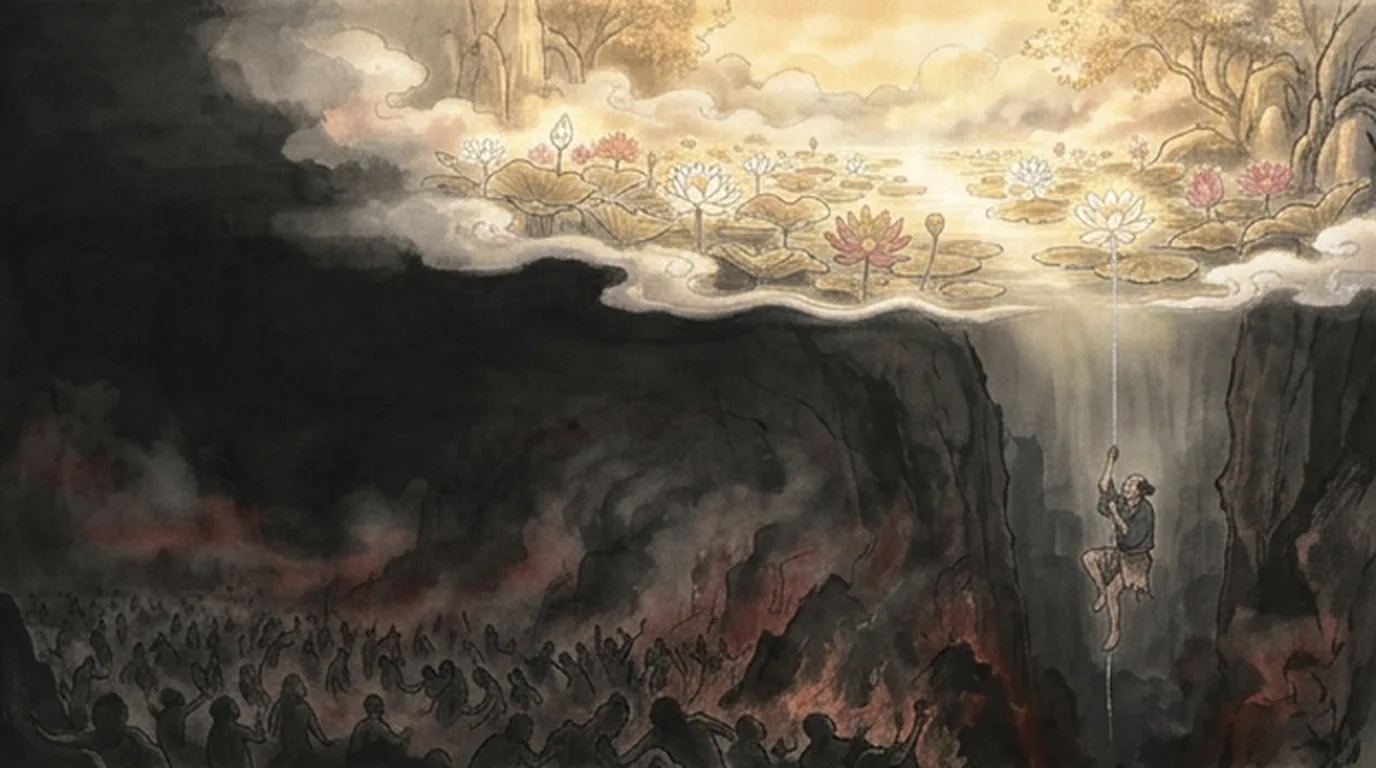
何気なく犍陀多が頭を挙げて、血の池の空を眺めますと、そのひっそりとした暗の中を、遠い遠い天上から、銀色の蜘蛛の糸が、まるで人目にかかるのを恐れるように、一すじ細く光りながら、するすると自分の上へ垂れて参るのではございませんか。
When Kandata happened to raise his head and look at the sky above the Pool of Blood, what should he see but a silver spider's thread slipping smoothly down toward him from the distant heavens through the silent darkness, shining faintly in a single strand, as if afraid of being seen.
-
-
JLPT N3 estimated
〜てばかりいる
Meaning: "Does nothing but ...": the same action again and again.
Form: Verb て-form + ばかり + いる(居る)
In this story
-
ですからさすが大泥坊の犍陀多も、やはり血の池の血に咽びながら、まるで死にかかった蛙のように、ただもがいてばかり居りました。
So even Kandata, great thief that he was, could only choke on the blood of the Pool of Blood and struggle like a dying frog.
-
-
JLPT N2 estimated
〜ではないか
Meaning: "Why, it's ...!": expresses surprise at what one sees (narrative style).
Form: Plain form + のではないか(ではございませんか)
In this story
-
何気なく犍陀多が頭を挙げて、血の池の空を眺めますと、そのひっそりとした暗の中を、遠い遠い天上から、銀色の蜘蛛の糸が、まるで人目にかかるのを恐れるように、一すじ細く光りながら、するすると自分の上へ垂れて参るのではございませんか。
When Kandata happened to raise his head and look at the sky above the Pool of Blood, what should he see but a silver spider's thread slipping smoothly down toward him from the distant heavens through the silent darkness, shining faintly in a single strand, as if afraid of being seen.
-
-
JLPT N4 estimated
〜ば
Meaning: "If ...": a condition; the result follows when the condition is met.
Form: Verb ば-form (行けば / すれば)
In this story
-
この糸に縋りついて、どこまでものぼって行けば、きっと地獄からぬけ出せるのに相違ございません。
If he clung to this thread and climbed on and on, he would surely be able to escape from Hell.
-
-
JLPT N4 estimated
受身(〜られる)
Meaning: Passive voice: the subject receives the action.
Form: Verb passive form(追い上げられる / 沈められる)
In this story
-
そうすれば、もう針の山へ追い上げられる事もなくなれば、血の池に沈められる事もある筈はございません。
Then he would never again be driven up the Mountain of Needles, and there would be no way he could be sunk in the Pool of Blood.
-
-
JLPT N3 estimated
〜はずがない
Meaning: "There is no way ...": the speaker is sure something cannot be true.
Form: Plain form + はずがない(筈はございません)
In this story
-
そうすれば、もう針の山へ追い上げられる事もなくなれば、血の池に沈められる事もある筈はございません。
Then he would never again be driven up the Mountain of Needles, and there would be no way he could be sunk in the Pool of Blood.
-
-
JLPT N3 estimated
〜うちに
Meaning: "While ...; before ... changes": within a period of time.
Form: Verb (plain) / Noun + の + うちに(中に)
In this story
-
ややしばらくのぼる中に、とうとう犍陀多もくたびれて、もう一たぐりも上の方へはのぼれなくなってしまいました。
After climbing for quite a while, Kandata finally grew tired and could not climb even one more pull higher.
-
今の中にどうかしなければ、糸はまん中から二つに断れて、落ちてしまうのに違いありません。
Unless he did something now, the thread would surely snap in two in the middle and he would fall.
-
-
JLPT N4 estimated
〜てしまう
Meaning: Shows that an action is completely finished, often with regret or an unwanted result.
Form: Verb て-form + しまう
In this story
-
ややしばらくのぼる中に、とうとう犍陀多もくたびれて、もう一たぐりも上の方へはのぼれなくなってしまいました。
After climbing for quite a while, Kandata finally grew tired and could not climb even one more pull higher.
-
あっと云う間もなく風を切って、独楽のようにくるくるまわりながら、見る見る中に暗の底へ、まっさかさまに落ちてしまいました。
In an instant he was cutting through the air, spinning round and round like a top, and before his eyes he fell headfirst into the depths of the darkness.
-
-
JLPT N4 estimated
〜かもしれない
Meaning: "Might ...; may ...": possibility.
Form: Plain form + かもしれない(かも知れません)
In this story
-
この分でのぼって行けば、地獄からぬけ出すのも、存外わけがないかも知れません。
At this rate, getting out of Hell might be surprisingly easy.
-
-
JLPT N4 estimated
〜なければならない
Meaning: "Must ...; have to ...".
Form: Verb ない-stem + なければならない(なりません)
In this story
-
もし万一途中で断れたと致しましたら、折角ここへまでのぼって来たこの肝腎な自分までも、元の地獄へ逆落しに落ちてしまわなければなりません。
If it broke halfway, even he — who had climbed all this way — would have to fall headfirst back into his old Hell.
-