
Idioms & Expressions
Idioms, sound words, old-style expressions, similes and casual speech in ごん狐 (Gon, the Little Fox).
-
Casual speech
とんがらしとんがらし
Meaning: chili pepper (a casual, old-fashioned form of とうがらし)
はたけへ入って芋をほりちらしたり、菜種がらの、ほしてあるのへ火をつけたり、百姓家の裏手につるしてあるとんがらしをむしりとって、いったり、いろんなことをしました。
He went into the fields and dug up potatoes all over the place, set fire to rapeseed stalks that had been left out to dry, pulled off the chili peppers hanging at the back of a farmer's house and made off with them, and did all sorts of things.
-
Old-style
或ある
Meaning: a certain; one (today written ある in hiragana: ある秋)
或秋のことでした。
It was one autumn.
-
Sound & mimetic word
からっとからっと
Meaning: (of the sky) clear and bright, with no clouds left
空はからっと晴れていて、百舌鳥の声がきんきん、ひびいていました。
The sky had cleared up bright, and the cry of a shrike rang out sharp and shrill.
-
Sound & mimetic word
きんきんきんきん
Meaning: sharp and shrill (of a high sound)
空はからっと晴れていて、百舌鳥の声がきんきん、ひびいていました。
The sky had cleared up bright, and the cry of a shrike rang out sharp and shrill.
-
Sound & mimetic word
どっとどっと
Meaning: all at once; in a rush (here, the water has suddenly risen a lot)
川は、いつもは水が少いのですが、三日もの雨で、水が、どっとましていました。
The stream usually has little water, but after three days of rain the water had risen all at once.
-
Sound & mimetic word
そうっとそうっと
Meaning: very quietly; very softly (a longer, stronger form of そっと)
ごんは、見つからないように、そうっと草の深いところへ歩きよって、そこからじっとのぞいてみました。
So as not to be found, Gon walked very quietly over to a place where the grass was deep, and from there he peeked out, keeping quite still.
-
Sound & mimetic word
ぼろぼろぼろぼろ
Meaning: ragged; worn to pieces
兵十はぼろぼろの黒いきものをまくし上げて、腰のところまで水にひたりながら、魚をとる、はりきりという、網をゆすぶっていました。
Hyōjū had tucked up his ragged black kimono and, standing in water up to his waist, was shaking the net for catching fish that is called a harikiri.
-
Casual speech
横っちょうよこっちょう
Meaning: the side (a casual word; today usually 横っちょ)
はちまきをした顔の横っちょうに、まるい萩の葉が一まい、大きな黒子みたいにへばりついていました。
On the side of his headbanded face, one round bush-clover leaf was stuck like a big mole.
-
黒子みたいにほくろみたいに
Meaning: like a mole (a round leaf is stuck to his cheek like a big dark spot)
Literal: like a mole on the skin
はちまきをした顔の横っちょうに、まるい萩の葉が一まい、大きな黒子みたいにへばりついていました。
On the side of his headbanded face, one round bush-clover leaf was stuck like a big mole.
-
Sound & mimetic word
ごちゃごちゃごちゃごちゃ
Meaning: all mixed up; in a mess
その中には、芝の根や、草の葉や、くさった木ぎれなどが、ごちゃごちゃはいっていましたが、でもところどころ、白いものがきらきら光っています。
Inside it, grass roots, leaves and bits of rotten wood were all mixed up together, but here and there something white was glittering.
-
Casual speech
ぶちこむぶちこむ
Meaning: to throw in roughly (ぶち in front of a verb makes it rough and strong)
兵十は、びくの中へ、そのうなぎやきすを、ごみと一しょにぶちこみました。
Hyōjū threw the eels and whiting into his fish basket, rubbish and all.
-
Sound & mimetic word
ぴょいとぴょいと
Meaning: with a light little jump
兵十がいなくなると、ごんは、ぴょいと草の中からとび出して、びくのそばへかけつけました。
As soon as Hyōjū was gone, Gon hopped out of the grass and ran up to the basket.
-
Casual speech
ちょいとちょいと
Meaning: a little; just for a bit (an old-fashioned, casual form of ちょっと)
ちょいと、いたずらがしたくなったのです。
He just felt like playing a little trick.
-
Sound & mimetic word
ぽんぽんぽんぽん
Meaning: lightly, one after another (of throwing things)
ごんはびくの中の魚をつかみ出しては、はりきり網のかかっているところより下手の川の中を目がけて、ぽんぽんなげこみました。
Gon grabbed the fish out of the basket and tossed them, one after another, into the stream below the place where the harikiri net was set.
-
Sound & mimetic word
とぼんとぼん
Meaning: plop (the sound of something dropping into water)
どの魚も、「とぼん」と音を立てながら、にごった水の中へもぐりこみました。
Every fish went "plop" and dived into the muddy water.
-
Idiom
音を立てるおとをたてる
Meaning: to make a sound
Literal: to raise a sound
どの魚も、「とぼん」と音を立てながら、にごった水の中へもぐりこみました。
Every fish went "plop" and dived into the muddy water.
-
Idiom
一ばんしまいにいちばんしまいに
Meaning: last of all; at the very end
Literal: at the number-one end
一ばんしまいに、太いうなぎをつかみにかかりましたが、何しろぬるぬるとすべりぬけるので、手ではつかめません。
Last of all he went to grab the fat eel, but it was so slimy that it kept slipping away, and he could not hold it with his paws.
-
Idiom
つかみにかかるつかみにかかる
Meaning: to set about grabbing; to go to grab (verb stem + にかかる = to start on doing)
一ばんしまいに、太いうなぎをつかみにかかりましたが、何しろぬるぬるとすべりぬけるので、手ではつかめません。
Last of all he went to grab the fat eel, but it was so slimy that it kept slipping away, and he could not hold it with his paws.
-
Sound & mimetic word
ぬるぬるぬるぬる
Meaning: slimy; slippery
一ばんしまいに、太いうなぎをつかみにかかりましたが、何しろぬるぬるとすべりぬけるので、手ではつかめません。
Last of all he went to grab the fat eel, but it was so slimy that it kept slipping away, and he could not hold it with his paws.
-
Sound & mimetic word
キュッきゅっ
Meaning: squeak (the sound the eel makes)
うなぎは、キュッと言ってごんの首へまきつきました。
The eel squeaked and wrapped itself around Gon's neck.
-
Idiom
そのとたんにそのとたんに
Meaning: at that very moment; just then
そのとたんに兵十が、向うから、
At that very moment Hyōjū, from the other side,
-
Old-style
ぬすとぬすと
Meaning: thief (a short old form of ぬすびと 盗人; today people say 泥棒)
「うわアぬすと狐め」と、どなりたてました。
shouted, "Hey, you thieving fox!"
-
Casual speech
狐めきつねめ
Meaning: that damned fox (め after a noun shows anger or contempt)
「うわアぬすと狐め」と、どなりたてました。
shouted, "Hey, you thieving fox!"
-
Old-style
お百姓おひゃくしょう
Meaning: farmer (an old word; today 百姓 can sound rude, and people say 農家 or 農家の人)
十日ほどたって、ごんが、弥助というお百姓の家の裏を通りかかりますと、そこの、いちじくの木のかげで、弥助の家内が、おはぐろをつけていました。
About ten days later, when Gon was passing behind the house of a farmer called Yasuke, Yasuke's wife was blackening her teeth in the shade of the fig tree there.
-
Old-style
家内かない
Meaning: wife (here, another man's wife; today 家内 is used only for one's own wife)
Literal: inside the house
十日ほどたって、ごんが、弥助というお百姓の家の裏を通りかかりますと、そこの、いちじくの木のかげで、弥助の家内が、おはぐろをつけていました。
About ten days later, when Gon was passing behind the house of a farmer called Yasuke, Yasuke's wife was blackening her teeth in the shade of the fig tree there.
-
Idiom
おはぐろをつけるおはぐろをつける
Meaning: to blacken one's teeth (in old Japan, married women dyed their teeth black, and did it afresh for special occasions)
十日ほどたって、ごんが、弥助というお百姓の家の裏を通りかかりますと、そこの、いちじくの木のかげで、弥助の家内が、おはぐろをつけていました。
About ten days later, when Gon was passing behind the house of a farmer called Yasuke, Yasuke's wife was blackening her teeth in the shade of the fig tree there.
-
Idiom
いつの間にかいつのまにか
Meaning: before one knows it; without noticing
Literal: in some interval or other
こんなことを考えながらやって来ますと、いつの間にか、表に赤い井戸のある、兵十の家の前へ来ました。
Thinking about this as he went along, before he knew it he had come to the front of Hyōjū's house, the one with the red well outside.
-
Sound & mimetic word
ぐずぐずぐずぐず
Meaning: (here) the sound of something simmering slowly; today this is ぐつぐつ, and ぐずぐず usually means "slowly; wasting time"
大きな鍋の中では、何かぐずぐず煮えていました。
In a big pot, something was simmering away.
-
Old-style
お午おひる
Meaning: noon; midday (an old spelling; today written お昼)
お午がすぎると、ごんは、村の墓地へ行って、六地蔵さんのかげにかくれていました。
After noon, Gon went to the village graveyard and hid behind the Six Jizō statues.
-
赤い布のようにあかいきれのように
Meaning: like a red cloth (the flowers cover the ground in one unbroken sheet of red)
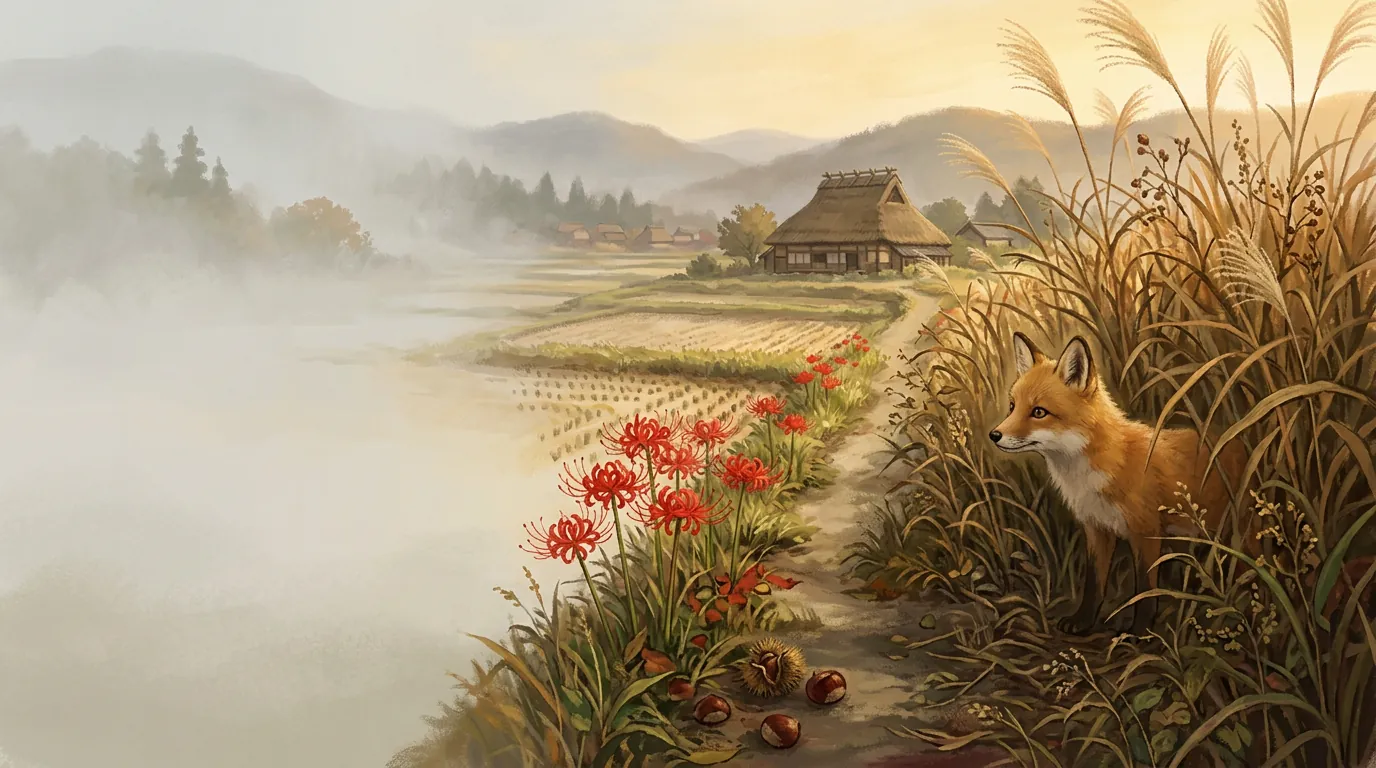
墓地には、ひがん花が、赤い布のようにさきつづいていました。
In the graveyard, red spider lilies were blooming on and on like a red cloth.
-
Sound & mimetic word
カーンかーん
Meaning: clang; bong (the sound of a bell)
と、村の方から、カーン、カーン、と、鐘が鳴って来ました。
Then, from the direction of the village, a bell began to ring: clang, clang.
-
Sound & mimetic word
ちらちらちらちら
Meaning: now and then; flickering in and out of view
やがて、白い着物を着た葬列のものたちがやって来るのがちらちら見えはじめました。
Before long, the people of the funeral procession, dressed in white kimonos, began to come into view now and then.
-
さつま芋みたいなさつまいもみたいな
Meaning: like a sweet potato (a round, red, healthy face)
いつもは、赤いさつま芋みたいな元気のいい顔が、きょうは何だかしおれていました。
His face, usually as healthy as a red sweet potato, somehow looked wilted today.
-
Casual speech
ははんははん
Meaning: aha; I see (said when you work something out)
「ははん、死んだのは兵十のおっ母だ」
"Aha, the one who died is Hyōjū's mother."
-
Old-style
おっ母おっかあ
Meaning: mom; ma (an old country word for mother)
「ははん、死んだのは兵十のおっ母だ」
"Aha, the one who died is Hyōjū's mother."
-
Idiom
床につくとこにつく
Meaning: to be sick in bed (it can also mean simply "to go to bed")
Literal: to take to one's bed
「兵十のおっ母は、床についていて、うなぎが食べたいと言ったにちがいない。
"Hyōjū's mother must have been lying sick in bed and said she wanted to eat eel.
-
Old-style
わしわし
Meaning: I (used by older men, and by country people in old stories; here Gon talking to himself)
ところが、わしがいたずらをして、うなぎをとって来てしまった。
But I played a trick and took the eel away.
-
Casual speech
ちょッちょっ
Meaning: tch; tsk (a click of the tongue that shows regret or anger; today usually ちぇっ)
ちょッ、あんないたずらをしなけりゃよかった。」
Tch. I wish I hadn't played a trick like that."
-
Casual speech
やすうりだアいやすうりだあい
Meaning: "going cheap!" (a street seller's call; だアい is だい stretched out so that it carries)
「いわしのやすうりだアい。
"Sardines, going cheap!
-
Idiom
いきのいいいきのいい
Meaning: very fresh (of fish)
Literal: with good life in it
いきのいいいわしだアい」
Nice fresh sardines!"
-
Idiom
いせいのいいいせいのいい
Meaning: lively; full of energy
Literal: with good force
ごんは、その、いせいのいい声のする方へ走っていきました。
Gon ran toward the lively voice.
-
Old-style
おくれおくれ
Meaning: give me ...; please (an old, friendly way to ask for something; today ください or ちょうだい)
「いわしをおくれ。」
"Give me some sardines."
-
Sound & mimetic word
どっさりどっさり
Meaning: lots; heaps
つぎの日には、ごんは山で栗をどっさりひろって、それをかかえて、兵十の家へいきました。
The next day, Gon gathered heaps of chestnuts in the hills and carried them in his arms to Hyōjū's house.
-
Idiom
ひどい目にあうひどいめにあう
Meaning: to have a terrible experience (ひどい目にあわされる = to be given a terrible time by someone)
Literal: to meet a terrible eye
おかげでおれは、盗人と思われて、いわし屋のやつに、ひどい目にあわされた」と、ぶつぶつ言っています。
Thanks to that, I was taken for a thief and that sardine seller gave me a terrible time," he was grumbling.
-
Sound & mimetic word
ぶつぶつぶつぶつ
Meaning: grumbling; muttering
おかげでおれは、盗人と思われて、いわし屋のやつに、ひどい目にあわされた」と、ぶつぶつ言っています。
Thanks to that, I was taken for a thief and that sardine seller gave me a terrible time," he was grumbling.
-
Casual speech
ぶんなぐるぶんなぐる
Meaning: to hit hard; to punch (ぶん in front of a verb makes it stronger)
かわいそうに兵十は、いわし屋にぶんなぐられて、あんな傷までつけられたのか。
Poor Hyōjū had been beaten by the sardine seller and even got a wound like that.
-
Idiom
月のいいつきのいい
Meaning: with a beautiful moon (月のいい晩 = a night when the moon is bright and clear)
Literal: with a good moon
月のいい晩でした。
It was a night with a fine moon.
-
Sound & mimetic word
ぶらぶらぶらぶら
Meaning: strolling along with no special purpose
ごんは、ぶらぶらあそびに出かけました。
Gon went out for a stroll.
-
Sound & mimetic word
チンチロリンちんちろりん
Meaning: the song of a pine cricket
チンチロリン、チンチロリンと松虫が鳴いています。
The pine crickets were singing, chin-chiro-rin, chin-chiro-rin.
-
Casual speech
おれあおれあ
Meaning: I ... (a spoken short form of おれは)
「おれあ、このごろ、とてもふしぎなことがあるんだ」
"Something very strange has been happening to me lately."
-
Casual speech
知らんしらん
Meaning: don't know (a short, rough negative; = 知らない)
「おっ母が死んでからは、だれだか知らんが、おれに栗やまつたけなんかを、まいにちまいにちくれるんだよ」
"Ever since my mother died, somebody, I don't know who, has been giving me chestnuts and matsutake and things, day after day."
-
Idiom
あとをつけるあとをつける
Meaning: to follow someone without being noticed
Literal: to attach oneself to someone's tracks
ごんは、ふたりのあとをつけていきました。
Gon followed behind the two of them.
-
Casual speech
ほんとかいほんとかい
Meaning: really? (かい is a soft, friendly question ending used mostly by men; ほんと = 本当)
「ほんとかい?」
"Really?"
-
Casual speech
ほんとだともほんとだとも
Meaning: of course it's true (とも at the end of a sentence = of course; certainly)
「ほんとだとも。
"Of course it's true.
-
Casual speech
あるもんだあるもんだ
Meaning: (strange things) do happen! (もんだ is a spoken form of ものだ, here showing surprise or deep feeling)
「へえ、へんなこともあるもんだなア」
"Well, strange things do happen."
-
Old-style
それなりそれなり
Meaning: with that; and after that (an old use, like それきり; today それなり means "in its own way; fairly")
それなり、二人はだまって歩いていきました。
After that, the two walked on without a word.
-
Sound & mimetic word
ひょいとひょいと
Meaning: suddenly and lightly; casually
加助がひょいと、後を見ました。
Kasuke suddenly glanced behind him.
-
Sound & mimetic word
びくっとびくっと
Meaning: with a start (from surprise or fear)
ごんはびくっとして、小さくなってたちどまりました。
Gon gave a start, made himself small, and stopped.
-
Idiom
小さくなるちいさくなる
Meaning: to make oneself small (shrinking down so as not to be seen)
Literal: to become small
ごんはびくっとして、小さくなってたちどまりました。
Gon gave a start, made himself small, and stopped.
-
Sound & mimetic word
ポンポンぽんぽん
Meaning: tock-tock (the beat of a wooden drum)
ポンポンポンポンと木魚の音がしています。
Tock, tock, tock, tock went the sound of a wooden drum.
-
Idiom
ふみふみふみふみ
Meaning: stepping on it again and again (a verb stem said twice shows an action repeated while doing something else)
兵十の影法師をふみふみいきました。
He went along stepping on Hyōjū's shadow again and again.
-
Old-style
思わっしゃるおもわっしゃる
Meaning: to think; to feel (an old country honorific, here used for the gods; = お思いになる)
「おれは、あれからずっと考えていたが、どうも、そりゃ、人間じゃない、神さまだ、神さまが、お前がたった一人になったのをあわれに思わっしゃって、いろんなものをめぐんで下さるんだよ」
"I've been thinking about it ever since, and somehow I feel that's no human being, it's the gods. The gods felt sorry for you, left all on your own, and they are kindly giving you all sorts of things."
-
Old-style
言うがいいいうがいい
Meaning: you should say (verb + がいい is an old way to give advice; today 言うといい or 言ったほうがいい)
だから、まいにち神さまにお礼を言うがいいよ」
So you should thank the gods every day."
-
Casual speech
いうんじゃアいうんじゃあ
Meaning: if (he) is going to say (a spoken short form of いうのでは)
おれが、栗や松たけを持っていってやるのに、そのおれにはお礼をいわないで、神さまにお礼をいうんじゃア、おれは、引き合わないなあ。
I take him chestnuts and matsutake, and yet he doesn't thank me; if he thanks the gods instead, it's not worth my trouble.
-
Idiom
引き合わないひきあわない
Meaning: it doesn't pay; it isn't worth the trouble (I get nothing back for what I do)
おれが、栗や松たけを持っていってやるのに、そのおれにはお礼をいわないで、神さまにお礼をいうんじゃア、おれは、引き合わないなあ。
I take him chestnuts and matsutake, and yet he doesn't thank me; if he thanks the gods instead, it's not worth my trouble.
-
Casual speech
こないだこないだ
Meaning: the other day (a spoken form of この間)
こないだうなぎをぬすみやがったあのごん狐めが、またいたずらをしに来たな。
That damned fox Gon who stole my eel the other day has come to play tricks again.
-
Casual speech
ぬすみやがるぬすみやがる
Meaning: to steal (verb stem + やがる is a rough ending that shows anger at what someone did)
こないだうなぎをぬすみやがったあのごん狐めが、またいたずらをしに来たな。
That damned fox Gon who stole my eel the other day has come to play tricks again.
-
Casual speech
ようしようし
Meaning: all right! (said when you make up your mind to do something)
「ようし。」
"All right."
-
Idiom
足音をしのばせるあしおとをしのばせる
Meaning: to walk softly so as not to be heard
Literal: to hide one's footsteps
そして足音をしのばせてちかよって、今戸口を出ようとするごんを、ドンと、うちました。
Then he crept up without a sound and, just as Gon was about to go out the door, shot him — bang.
-
Sound & mimetic word
ドンどん
Meaning: bang (the sound of a gun)
そして足音をしのばせてちかよって、今戸口を出ようとするごんを、ドンと、うちました。
Then he crept up without a sound and, just as Gon was about to go out the door, shot him — bang.
-
Sound & mimetic word
ばたりばたり
Meaning: with a thud (of someone or something falling flat)
ごんは、ばたりとたおれました。
Gon fell with a thud.
-
Idiom
目につくめにつく
Meaning: to catch one's eye; to be noticed
Literal: to attach to one's eye
家の中を見ると、土間に栗が、かためておいてあるのが目につきました。
When he looked inside the house, chestnuts set down in a pile on the earth floor caught his eye.
-
Idiom
目を落とすめをおとす
Meaning: to look down at
Literal: to drop one's eyes
「おや」と兵十は、びっくりしてごんに目を落しました。
"Oh!" said Hyōjū, and he looked down at Gon in surprise.
-
Old-style
お前おまい
Meaning: you (おまい is a country way of saying おまえ)
「ごん、お前だったのか。
"Gon, so it was you.
-
Sound & mimetic word
ぐったりぐったり
Meaning: limp; with no strength left
ごんは、ぐったりと目をつぶったまま、うなずきました。
Gon, limp, with his eyes still closed, nodded.