
Blog · Rashōmon
5 Japanese Expressions from Rashōmon
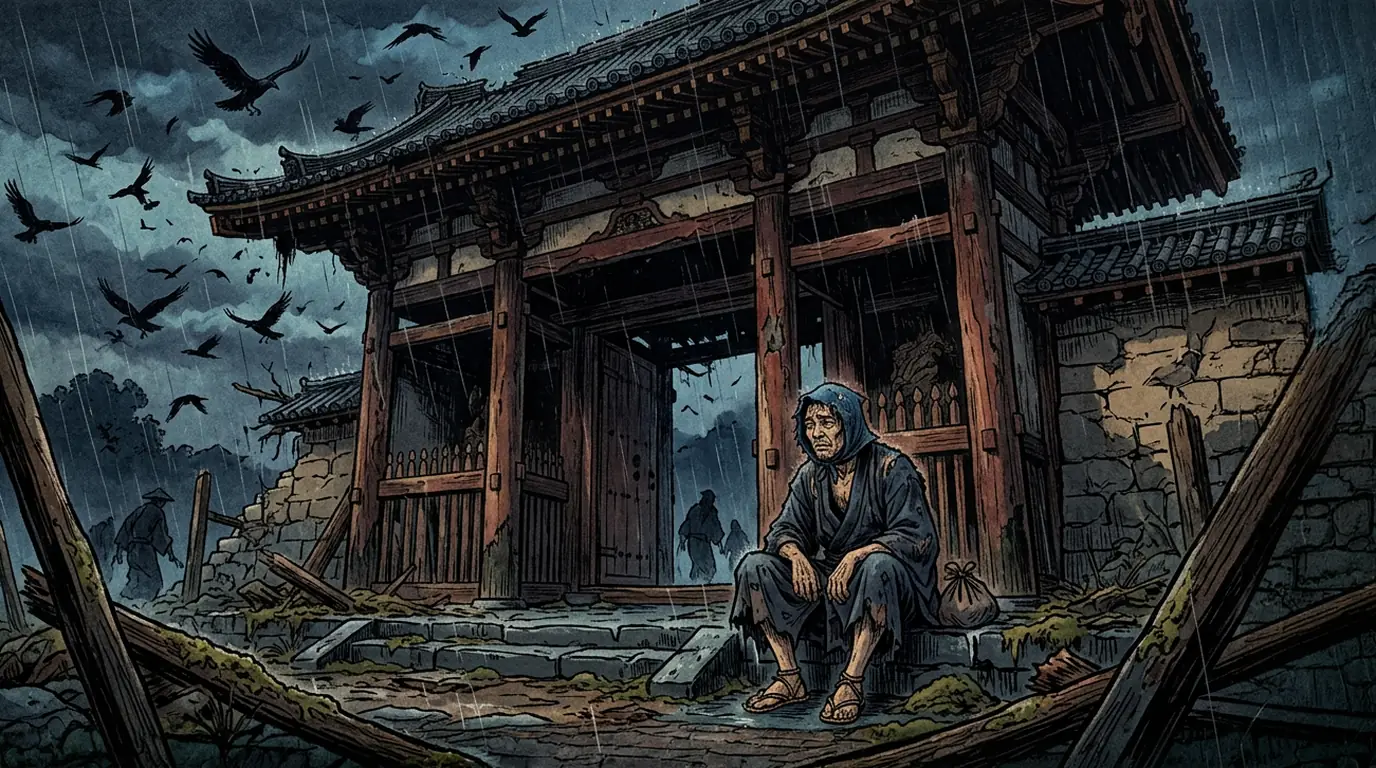
Akutagawa Ryūnosuke wrote Rashōmon in 1915. The story is short: a servant who has just lost his job sits under a ruined city gate in the rain, trying to decide whether to starve or become a thief. The Japanese is old-fashioned in places, but many of its expressions are still used every day. Here are five of them, with the line where each one appears in the story and a few examples of how people use them today.
1. 途方に暮れる(とほうにくれる)— to be at a loss
途方 means "a way" or "a means," and 暮れる means "to grow dark." So the picture is of the road ahead going dark: you have no idea what to do next.
雨にふりこめられた下人が、行き所がなくて、途方にくれていた
A servant, trapped by the rain, had nowhere to go and was at a loss what to do.
The narrator stops to correct himself here: it is not really that the servant was "waiting for the rain to stop" — he simply had nowhere else to be.
Today:
- 終電を逃して、駅の前で途方に暮れた。
I missed the last train and stood in front of the station, not knowing what to do. - 財布をなくして途方に暮れていたら、知らない人が助けてくれた。
I had lost my wallet and was at a loss, when a stranger helped me.
Tip: It is almost always used in the past or the ~ている form: 途方に暮れた, 途方に暮れている.
2. 高を括る(たかをくくる)— to assume something will be easy
高 is "an amount," and 括る means "to tie up." You have already wrapped up your estimate, so you stop paying attention.
下人は、始めから、この上にいる者は、死人ばかりだと高を括っていた。
From the start, the servant had taken it for granted that there would be nothing up there but dead people.
He is wrong, of course — and that is the point. 高を括る almost always suggests that the easy assumption turned out to be a mistake.
Today:
- 簡単な試験だと高を括っていたら、全然解けなかった。
I assumed the test would be easy, and I couldn't answer anything. - 雨は降らないだろうと高を括って、傘を持たずに出かけた。
I figured it wouldn't rain and went out without an umbrella.
3. 息を殺す(いきをころす)— to hold one's breath
Literally "to kill one's breath." You breathe as quietly as you can so that no one hears you.
一人の男が、猫のように身をちぢめて、息を殺しながら、上の容子を窺っていた。
A man, curled up like a cat and holding his breath, was peering at what was happening above.
Today:
- 子どもたちは息を殺して、鬼が通り過ぎるのを待った。
The children held their breath and waited for "it" to walk past. (in hide-and-seek) - 観客は息を殺して、最後のシュートを見守った。
The crowd held its breath as they watched the final shot.
Tip: 息を止める just means to stop breathing. 息を殺す adds silence and tension — you are hiding, or waiting for something important.
4. 手段を選ばない(しゅだんをえらばない)— to do whatever it takes
手段 is "a means" or "a method." If you don't choose your means, you will use any means at all, good or bad.
どうにもならない事を、どうにかするためには、手段を選んでいる遑はない。
To do something about a situation that can't be helped, there is no time to be choosy about how.
The whole story turns on this idea. The servant keeps telling himself he will do whatever it takes — but he can't quite say the word "thief" until the very end.
Today:
- 彼は勝つためなら手段を選ばない。
He'll do anything to win. - 目的のためには手段を選ばない、という考え方には賛成できない。
I can't agree with the idea that the end justifies the means.
Tip: It usually has a negative feel: the person is willing to cross a line.
5. 大目に見る(おおめにみる)— to overlook; to let someone off
Literally "to look with a big eye" — a generous look that doesn't notice small faults.
大方わしのする事も大目に見てくれるであろ。
She would probably forgive what I'm doing, too.
The old woman says this about the dead woman whose hair she is pulling out: that woman did bad things to survive, so she would understand. であろ is an old way of saying であろう.
Today:
- 初めてのミスだから、今回は大目に見よう。
It's your first mistake, so I'll let it go this time. - 子どものいたずらくらい、大目に見てあげてください。
Please go easy on a child's little prank.
Read it in the story
All five expressions come up in the first half of the story, so you will meet them early. When you do, try reading on without tapping — you may find you already know what they mean.