
Blog · The Spider's Thread
5 Everyday Expressions from The Spider's Thread
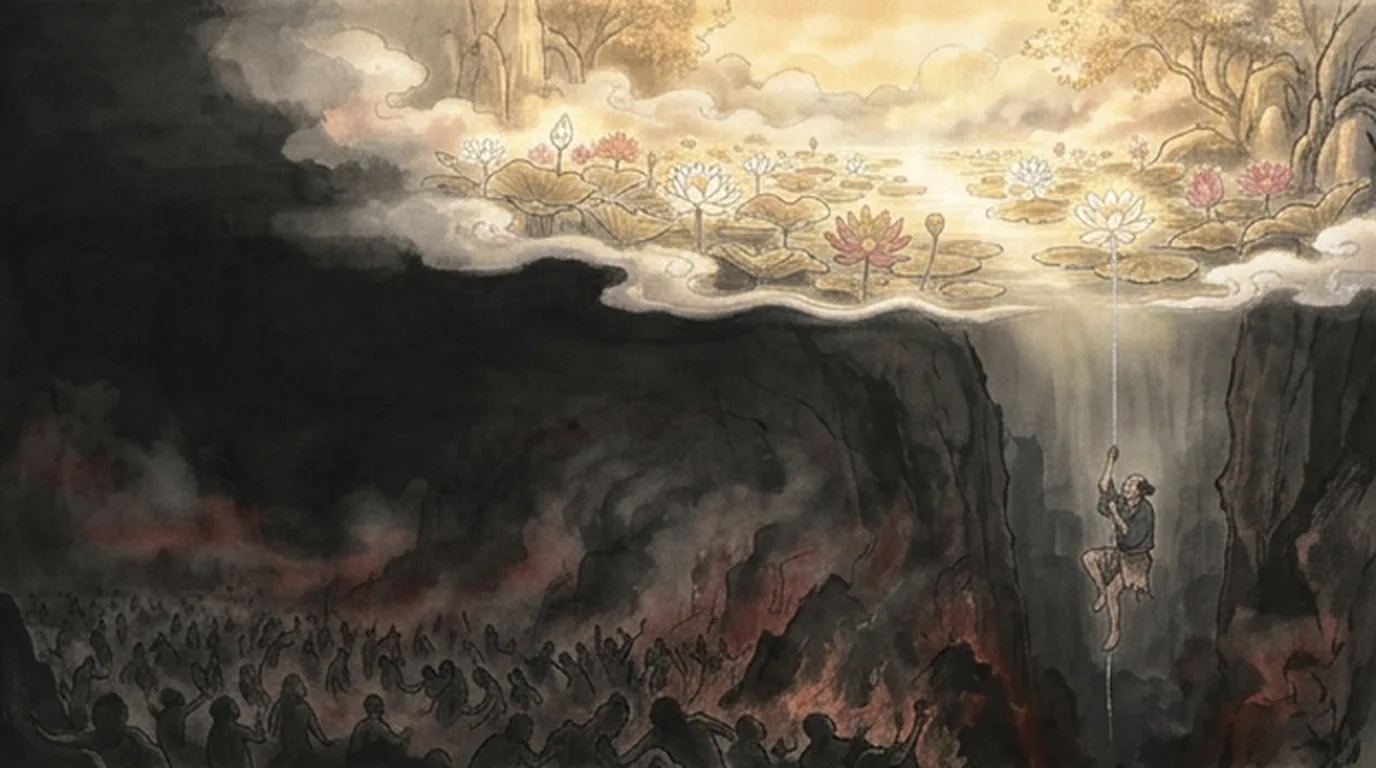
The Spider's Thread (1918) is one of Akutagawa Ryūnosuke's shortest and best-loved stories. One morning in Paradise, the Buddha looks down through a lotus pond into Hell, where a great thief named Kandata is suffering. Kandata once spared the life of a small spider, so the Buddha lowers a single silver spider thread to save him. The story was written for children, and its Japanese is gentle and clear. Here are five expressions from it that you will hear in everyday Japanese today.
1. 何とも言えない(なんともいえない)— indescribable
In the story it is written 何とも云えない, with an older kanji for 言う. It means "I can't put it into words" — usually about something very good.
そのまん中にある金色の蕊からは、何とも云えない好い匂が、絶間なくあたりへ溢れて居ります。
From the golden centers of the flowers, a fragrance too lovely for words drifts out endlessly all around.
Today:
- この店のカレーは何とも言えないおいしさだ。
The curry at this place is delicious beyond words. - 山の上から見た朝日は、何とも言えない美しさだった。
The sunrise from the top of the mountain was indescribably beautiful.
Tip: It has a second meaning: "I can't say for sure." 明日の天気は、まだ何とも言えない。— It's too early to say what tomorrow's weather will be.
2. せっせと — busily; diligently
Working steadily and hard, without stopping.
細く光っている蜘蛛の糸を、一列になりながら、せっせとのぼって参ります。
In a single line, they come climbing busily up the thin, shining spider thread.
This is the moment Kandata looks down and sees the other sinners following him up his thread.
Today:
- アリがせっせとえさを運んでいる。
The ants are busily carrying food. - 祖母は毎朝せっせと庭の手入れをしている。
Every morning my grandmother works hard in the garden.
3. あっと言う間(あっというま)— in an instant
"In the time it takes to say ah." Today it is usually written あっという間.
あっと云う間もなく風を切って、独楽のようにくるくるまわりながら……
Before he could even cry out, he was cutting through the air, spinning round and round like a top…
あっと言う間もなく means "before you could even say ah" — faster than an instant.
Today:
- 夏休みはあっという間に終わった。
The summer vacation was over in no time. - 人気のパンは、あっという間に売り切れた。
The popular bread sold out in a flash.
4. 見る見るうちに(みるみるうちに)— before one's very eyes
In the story: 見る見る中に. Today it is written 見る見るうちに or みるみるうちに. It describes a change you can actually watch happening.
見る見る中に暗の底へ、まっさかさまに落ちてしまいました。
Before the Buddha's very eyes, he fell headfirst into the depths of the darkness.
Today:
- 空が見る見るうちに暗くなった。
The sky grew dark before our eyes. - 薬を飲んだら、熱が見る見るうちに下がった。
After I took the medicine, my fever went down in no time.
Tip: あっという間 is about how short the time feels. 見る見るうちに is about a change you can see as it happens.
5. 一部始終(いちぶしじゅう)— the whole story, from beginning to end
A four-character compound: 一部 "one part" + 始終 "beginning and end" — every part of it.
御釈迦様は極楽の蓮池のふちに立って、この一部始終をじっと見ていらっしゃいました
The Buddha stood at the edge of the lotus pond in Paradise and watched the whole thing, from beginning to end.
Today:
- 事故の一部始終を見ていた人が、警察に話をした。
A person who saw the whole accident talked to the police. - 友だちに、けんかの一部始終を話した。
I told my friend everything about the argument, from start to finish.
Tip: It usually goes with verbs of seeing, hearing and telling: 一部始終を見る, 聞く, 話す.
Read it in the story
The Spider's Thread is about 2,900 characters long, so you can read it in one sitting. It is a good first story if you are just starting to read real Japanese literature.